Inside an Upper-Elementary Homeschool Day: A Realistic 3-Hour Rhythm
An upper-elementary homeschool day does not need to imitate six hours in a classroom. It does need a shape: a clear start, focused work while attention is strongest, movement between demanding blocks, and an obvious point when school is finished.
Below is a sample day for an 8- to 10-year-old, not a prescription and not a customer case study. It is the kind of rhythm HomeSchool.You was designed to support, but it also works with library books, paper curricula, and other learning tools.
The day at a glance
| Time | Block | What it is for |
|---|---|---|
| 9:00–9:15 | Start and choose | Preview the day, pick an interest, remove uncertainty |
| 9:15–9:50 | Math | New idea, guided examples, short practice |
| 9:50–10:05 | Movement break | Snack, stretch, outside reset |
| 10:05–10:40 | Reading and writing | Read, discuss, respond in writing |
| 10:40–11:20 | Science or social studies | One focused lesson plus a real task |
| 11:20–11:45 | Independent choice | Language, skill practice, or an educational game |
| 11:45–12:15 | Create, record, and stop | Art, music, project work, progress check |
That is about three hours including breaks. Some days will be shorter. A cooking project, park visit, long read-aloud, or science build can make another day longer without making it more academically serious.
9:00 — start with a small plan
The first job is not teaching. It is making the day legible.
Open a planner, write three priorities on paper, or use a dashboard that shows the next activity. Keep the list small enough that a child can see the finish line. A useful upper-elementary plan might be:
- One math lesson and practice set
- Reading plus a written response
- One science or social-studies investigation
Everything else is a choice block. This distinction matters: when twelve tiles all look equally urgent, children spend energy deciding what school even is.
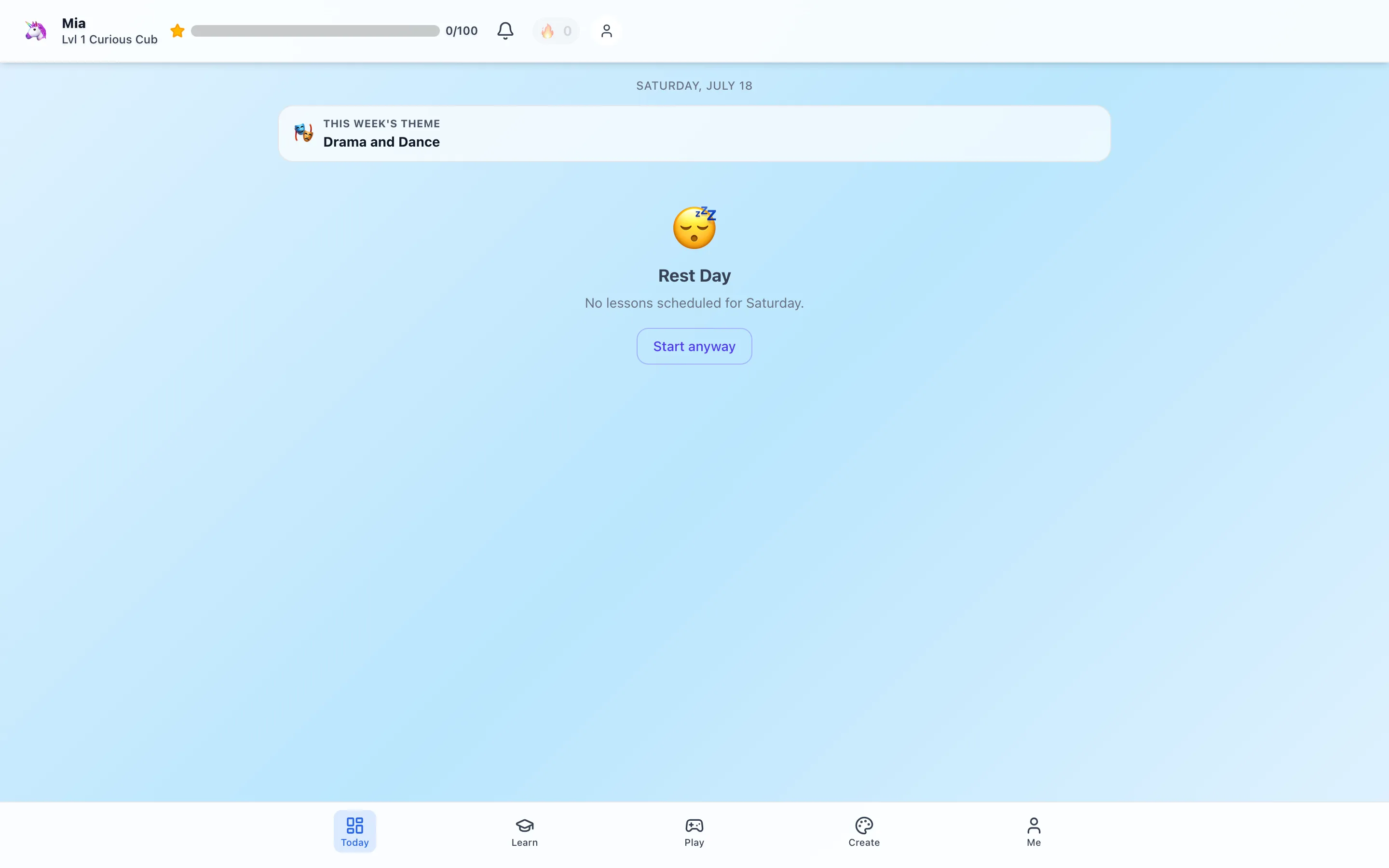
HomeSchool.You can recommend a next activity from a child's age, interests, and progress. A parent can ignore that recommendation. The dashboard is a starting point, not an authority.
9:15 — do the hardest core subject first
For many children, math or writing deserves the freshest attention. Keep the block narrow:
- Review one thing from yesterday.
- Teach or read one new idea.
- Work a few examples together.
- Let the child try independently.
- Stop before accuracy collapses into guessing.
Inside HomeSchool.You, a course lesson combines facts, a quiz, and a hands-on prompt. That can structure the block, but the parent still watches for the important signal: does the child understand the idea, or have they only learned which button to press?
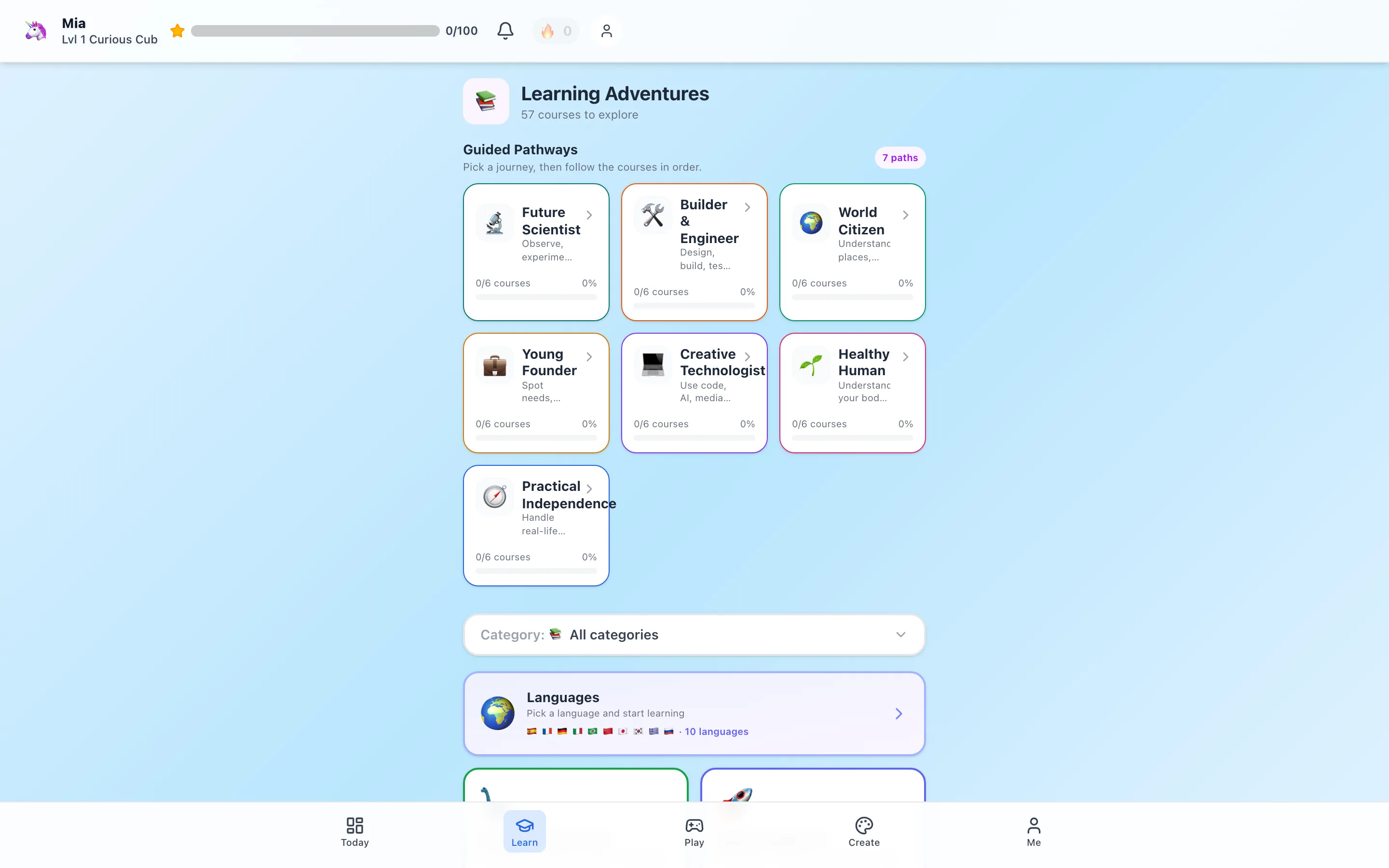
The complete catalog spans 57 launch courses across 14 subjects. That breadth is useful only if the daily choice stays small. Our curriculum overview explains what is included; the point of this schedule is not to use all of it at once.
9:50 — reset the body
A fifteen-minute break is not a reward for good work. It is part of the learning design. Snack, carry laundry upstairs, walk around the block, shoot baskets, or turn on music and move.
Avoid turning every break into another screen choice. The next block is easier when the brain actually changed contexts.
10:05 — read, talk, then write something small
Reading and writing can share one block:
- Read a chapter, article, poem, or lesson.
- Ask the child to tell you what changed, surprised them, or did not make sense.
- Write one paragraph, a comparison, a labeled diagram, or three strong sentences.
Upper-elementary writing grows through frequent, manageable output. A polished five-paragraph essay every day is not required. A child who can explain an idea clearly, revise a confusing sentence, and support a claim with evidence is doing real work.
If reading is substantially harder than expected, the answer is not simply more independent screen practice. Read together, reduce the volume, use audio support, and consider targeted professional help.
10:40 — connect a lesson to the real world
Science and social studies are where a homeschool day can stop feeling like a stack of assignments.
A 20-minute science lesson might lead to measuring shadows outside, building a paper bridge, identifying a leaf, sketching a body system, or exploring a 3D model. A geography lesson might end with planning a park visit or finding a country on a map.
HomeSchool.You includes 575 hands-on activities, 3D science labs, and guides to 541 parks. The device gives the prompt; the best part often happens away from it. For examples, see our 3D science lab walkthrough and virtual field-trip guide.
11:20 — allow a bounded independent choice
Now offer two or three choices, not an endless catalog:
- Continue a language program
- Practice a weak skill
- Explore a career connected to today's subject
- Play an educational game
HomeSchool.You has 84 games, but they do not all function the same way. Educational games and labs can be part of the learning block. Arcade-style games use a separate daily budget controlled by the parent. Children can earn arcade minutes through learning, and the session has a clear limit.
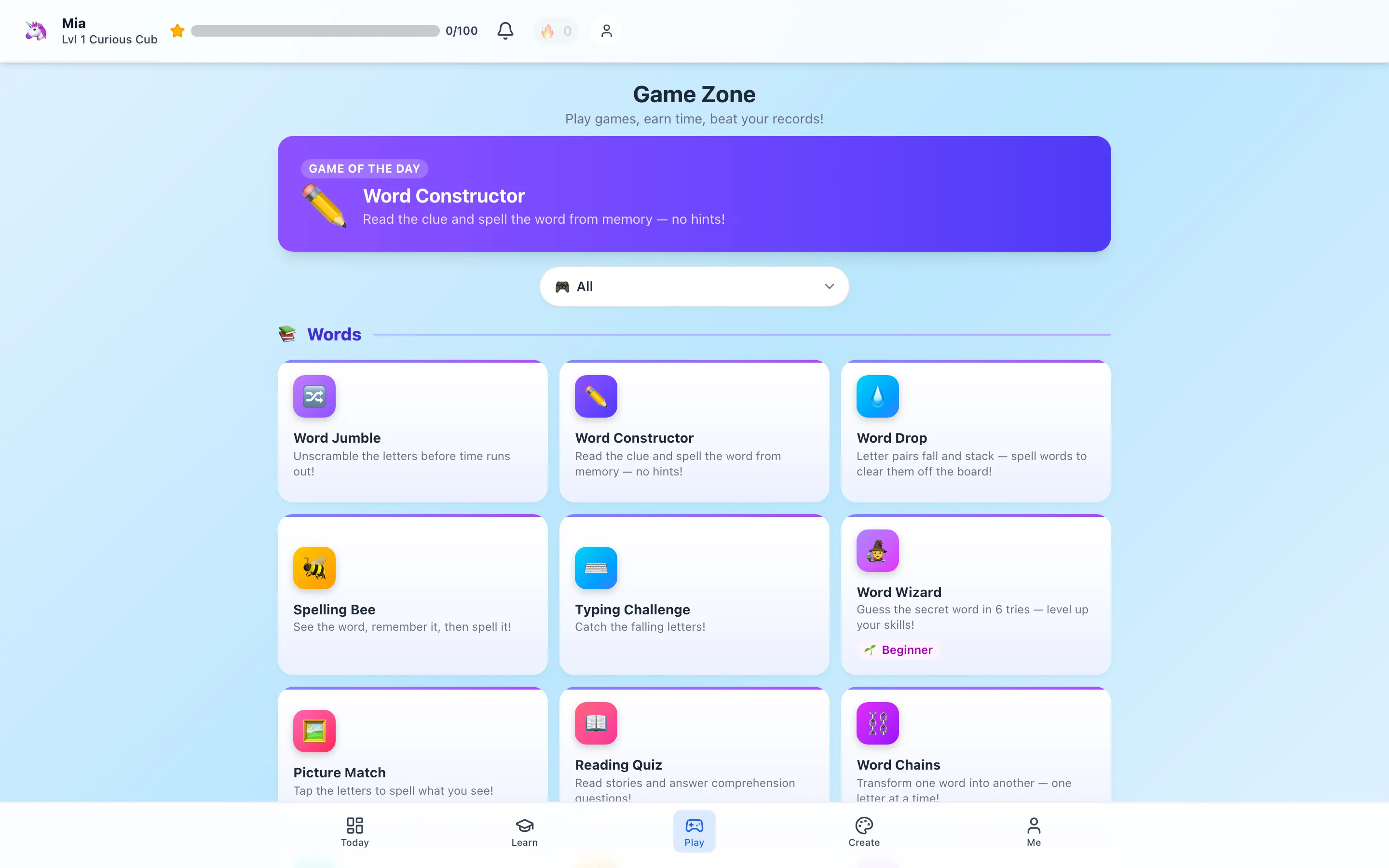
That distinction is central to our guide to game-based learning versus gamified practice: a game can be the place where thinking happens, or it can merely decorate a worksheet with points.
11:45 — make something, record the day, and stop
End with creation or reflection. Draw, make a beat, finish a model, cook, add a project to a portfolio, or write tomorrow's question.
Then record what actually happened. HomeSchool.You can turn learning activity into parent-managed progress, attendance, annual-report, portfolio, and transcript-style records. It is still the parent's job to review those records and meet local requirements. Our plain-English homeschool records guide explains the difference between a progress report and an official transcript.
Finally, stop. A visible endpoint protects motivation. More available content is not a reason to keep a child working after the day's goals are met.
What makes this rhythm work
The exact clock matters less than four rules:
- Make the finish line visible. A child should know what “done” means.
- Alternate effort and mode. Read, move, build, write, speak, create.
- Use choice inside boundaries. Two useful options beat fifty open tabs.
- Let completed work be complete. Do not fill every saved minute with another assignment.
That is the practical version of a calm homeschool day: enough structure to keep moving, enough flexibility to follow curiosity, and enough restraint to end on time.
If the choice block is the part your child anticipates, our kids' language-app comparison and music studio walkthrough show two ways to use it without stretching the whole school day.
Editorial note
This is a first-party guide written by the team that builds HomeSchool.You. It describes a sample workflow, not the routine of a named customer, and it does not replace your state's homeschool requirements or advice from a qualified educator who knows your child.
Frequently asked questions
How long should an upper-elementary homeschool day take?
Many families can cover focused academic work in roughly two to four hours, but there is no universal number. A child's age, attention, support needs, state rules, and the amount of reading or project work all matter.
Does this schedule require HomeSchool.You?
No. The rhythm works with books, printables, another curriculum, or a mix. The examples show where HomeSchool.You can fit because we know our own product well.
What if my child finishes early?
Stop when the day's learning goals are met. Extra time can go to reading, outdoor play, practical work, a creative project, or nothing scheduled at all.
What if my child needs more help with math or reading?
Shorten independent blocks and add direct parent instruction or specialist support. An app can provide practice and feedback, but it does not replace targeted human help when a child is struggling.
Can siblings use the same schedule?
They can share the same broad rhythm while doing different material. One child might read independently while another works beside a parent, then both meet for science, art, cooking, or a field trip.