How to Turn a National Park Visit Into a Homeschool Day
A good park day does not need to look like school moved outdoors. The useful version is lighter: decide what the child might investigate, let the real place do most of the teaching, and save one small piece of evidence afterward.
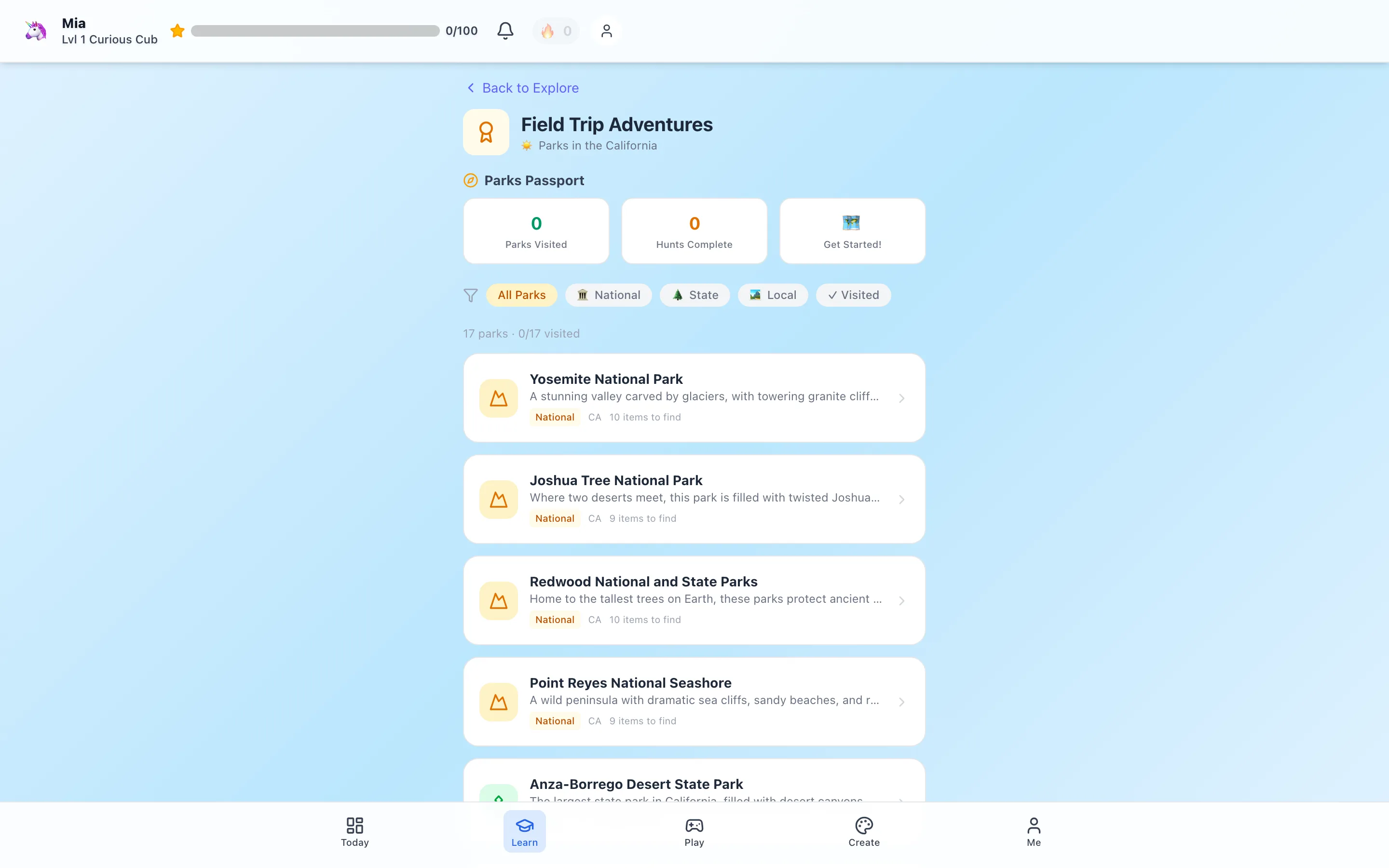
HomeSchool.You was built around that rhythm. Its park catalog covers 541 national, state, and local parks across all 50 states, with 4,443 observation prompts. A child can browse the catalog, heart a park, and send an in-app alert to the parent; the park then appears in the child's shared Travel Wish List. That makes the child's curiosity part of family planning instead of a list chosen only by adults.
This guide works with our park tools, the official National Park Service app, or a notebook and pencil.
The 15-minute plan before you leave
1. Start with one park-specific question
Generic prompts such as “find a rock” work anywhere. A stronger question depends on the place:
- At Yosemite: how did ice and water shape this valley?
- At Acadia: what changes where land and ocean meet?
- At Joshua Tree: how do living things handle heat and limited water?
- At Gettysburg: how does the landscape help explain what happened here?
You do not need to lecture before the visit. Ask the question, let the child make a prediction, and return to it later.
2. Choose a short observation menu
HomeSchool.You park records contain 8–10 finds selected for that exact park. Print the full page if you want, but do not require a young child to finish every item. Pick three for ages 3–5, five for ages 6–8, or let an older child choose a category such as geology, wildlife, history, or plant adaptations.
The National Park Service also publishes self-guided educational activities for some sites. For example, its Valley Forge homeschool resources are organized around history and place, while Acadia education activities include park scavenger hunts. Check the official page for the park you are visiting; offerings differ by site.
3. Check conditions from the official source
Learning content is not a conditions report. Before leaving, check the managing agency for closures, reservations, weather, wildlife guidance, accessibility, fire restrictions, tides, and permitted routes. The official National Park Service app covers more than 400 national parks and lets families download park information for offline use.
4. Pack for observation, not a classroom
A useful small kit is:
- water, weather protection, and the safety gear the location requires;
- one printed guide or small notebook;
- pencil and a few colored pencils;
- a phone or camera controlled by the parent;
- a simple magnifier, if allowed and appropriate.
Avoid bags full of worksheets. The point is to look up.
What to do during the visit
Let the child lead some of the noticing
Ask “What do you notice?” before naming the answer. Follow with “What makes you think that?” Those two questions turn a sighting into observation and evidence without making the walk feel like a quiz.
When a child finds an item, slow down for one detail:
- describe its shape, color, texture, motion, sound, or location;
- compare it with another thing nearby;
- sketch it;
- ask how it might change by season;
- connect it to the park question.
Finding fewer things carefully is better than rushing through every checkbox.
Adapt the same place for different ages
Ages 3–5: notice and name. Choose three safe observations. Ask for a color, shape, sound, movement, or simple drawing. Keep the child close and make the adult responsible for the route.
Ages 6–8: observe and describe. Choose five finds. Have the child sketch one, record two details, and explain one connection: “The roots help hold this soil,” or “This shell shows an animal lived here.”
Ages 9–10: classify and support a claim. Ask the child to group observations, compare two features, and use visible evidence to answer the opening question. “The rounded rock and wide valley both support the idea that ice shaped this area” is more meaningful than ten unchecked facts.
Keep wildlife and wild places wild
A checklist never outranks safety or stewardship. Do not approach, feed, call, chase, touch, or surround wildlife. Do not cross barriers, leave approved routes, climb where prohibited, or collect plants, rocks, feathers, fossils, or cultural objects. A distant observation, track, sound, or ranger-approved sign can count. If an item is absent, write “not seen today.”
Nature identification tools can support curiosity, but they can be wrong. Never use an app to decide whether a plant, mushroom, animal, water source, or terrain is safe.
A simple Yosemite example
Suppose the family question is: How did natural forces shape Yosemite Valley?
Before the visit, the child chooses five finds from the Yosemite guide. During a safe, permitted route, they might notice a granite face, a waterfall, signs of glacial shaping, a giant sequoia in an appropriate grove, or evidence of an animal rather than the animal itself.
For a six-year-old, the output could be a drawing with two labels. For a ten-year-old, it could be three sentences connecting granite, water, and valley shape. The family may see only two target items; the learning still works because the child observed carefully and answered the question with evidence.
See the public Yosemite scavenger-hunt preview for the actual place-specific checklist.
The 10-minute follow-up at home
Choose one, not all, of these:
- Tell: the child explains the best discovery to another family member.
- Draw: a labeled field sketch with one question still unanswered.
- Write: three observations and one evidence-based conclusion.
- Map: trace the route and mark where an observation happened.
- Compare: place two photos side by side and describe a difference.
- Research: use an official park or museum source to answer one question from the day.
In HomeSchool.You, the visit can become part of the child's park-passport memory and parent-managed portfolio. A photo, labeled drawing, narration, or paragraph is stronger evidence than an app saying “completed.”
How to record the day honestly
Parents can record the subjects actually present—perhaps science, geography, history, writing, art, or physical education—along with the date, location, time, and child output. Do not count every possible subject merely because it could have happened.
HomeSchool.You provides parent-managed attendance and portfolio tools, but it is not an accredited school and does not issue teacher grades or official credit. Families remain responsible for their own state requirements.
Use the child’s wishlist as the beginning
The planning sequence we want is intentionally shared:
- The child explores parks and hearts a place.
- The parent gets an in-app alert.
- The choice joins that child's Travel Wish List.
- The family decides what is realistic and when.
- The app supplies the park-specific hunt; the official agency supplies current conditions.
- The visit becomes a memory and, when useful, a learning artifact.
That is more valuable than treating parks as a static list of “field trips.” It gives children a voice in where the family goes and gives parents enough structure to turn the day into learning without taking the day over.
Explore the 28 public park-guide examples or see the complete outdoor-learning feature.
Methodology and limits
Product counts come from the same park records used by HomeSchool.You as of September 1, 2026: 541 parks and 4,443 prompts. National Park Service capabilities and example activities were checked against the official NPS pages linked above. Park access and programs change; always verify the specific official park page before a visit. HomeSchool.You is independent and is not affiliated with or endorsed by the National Park Service or a state park agency.
Frequently asked questions
Can a national park visit count as a homeschool day?
Often, yes, when the visit includes intentional observation, discussion, reading, or a child-created record. Attendance and subject requirements vary by state, so parents should apply their own rules rather than treating an app completion as automatic credit.
What subjects can children learn at a national park?
Science, geography, history, art, writing, math, and physical education can all fit naturally. The strongest subject depends on the park and on what the child actually observes and produces.
How much schoolwork should we bring to a park?
Very little. One question, a short place-specific checklist, and one optional way to record the day are usually enough. A family visit should still feel like exploration.
What if my child cannot find everything on a scavenger hunt?
That is normal. Park observations depend on season, weather, closures, wildlife, and route. Never leave an allowed area or approach wildlife to finish a list; turn a missing item into a question.
How does HomeSchool.You help plan park days?
Children can browse 541 parks and heart the places they want to explore. Parents receive an in-app alert, and each choice appears in the child's Travel Wish List. Every park includes 8 to 10 place-specific finds, trivia, narration, and a printable guide.