Best Online Homeschool Programs for Elementary Kids in 2026
Trial offer update — September 17, 2026: HomeSchool.You's Summer Welcome Special offered a 7-day free trial with no credit card required, valid through September 15, 2026. That special is no longer active. New standard signups now receive a 3-day free trial with a credit card required upfront. The selected plan bills automatically when the trial ends unless canceled beforehand. Existing users keep their already-promised trial terms. See current plans and trial terms.
Disclosure: HomeSchool.You appears on this list and we build it. The free option is ranked first because for many families it's genuinely the right starting point.
Elementary is the easiest stage to homeschool with online tools — the content is well-covered, competition is strong, and prices are lower than at high school level. Here's what's actually worth considering for grades K–5.
Comparison
| Program | Price | Ages | Complete curriculum? | Records |
|---|---|---|---|---|
| Khan Academy Kids | Free | 2–8 | Nearly, for K–2 | No |
| HomeSchool.You | $20/mo, up to 4 children | 3–10 | Broad, not accredited | Parent-managed attendance, progress, annual report, portfolio, transcript-style export |
| ABCmouse | $45/year | 2–8 | For PreK–2 | No |
| Time4Learning | $39.95/mo per student | PreK–12 | Yes | Yes |
| Miacademy | $48/mo per child | K–8 | Yes | Yes |
| Power Homeschool | $99/mo per student | PreK–12 | Yes | Yes |
| SplashLearn | ~$11.99/mo | PreK–5 | Math + reading only | Limited |
| IXL | From ~$9.95/mo | PreK–12 | Practice, not curriculum | Detailed |
Prices verified against published company pages, August 2026.
Start here if budget matters: Khan Academy Kids
Free, no ads, nonprofit. For kindergarten through roughly 2nd grade it covers early literacy, phonics, math, and social-emotional learning well enough that many families use nothing else at that stage. Its ceiling is age 8. Full comparison.
Best value for 2+ children: HomeSchool.You
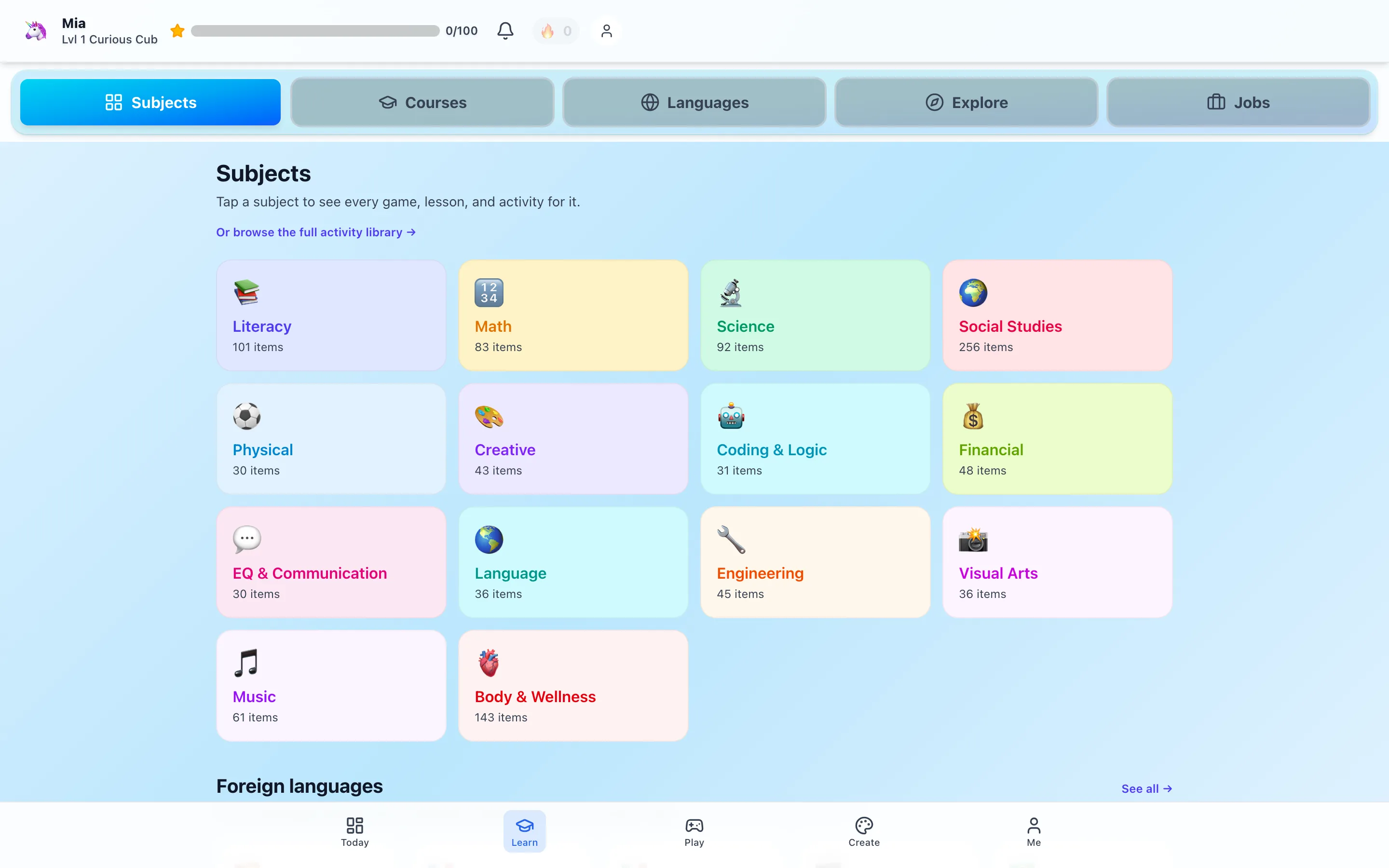
$20/month for up to four children ages 3–10. 57 courses across 14 subjects, 84 games, 575 hands-on activities, 10 languages, 541 park virtual field trips, art and music studios, and a 428-question diagnostic that maps to a 120-node skill graph for routing what comes next.
Honest limits: no teacher-issued grades or official credit-bearing transcript, no live teaching, and we stop at 10 — so this covers elementary but not the transition to middle school. Our homeschool curriculum page lists what's included, and our records guide defines the parent-managed exports.
Cheapest for PreK–2: ABCmouse
$45/year, up to 3 child profiles, 30-day trial. Well-built for pre-readers and early readers. Runs out around 2nd grade. Full comparison.
Best complete curriculum with records: Time4Learning
$39.95/month per student with automated attendance, graded lessons, and portfolio exports, plus 10–25% family discounts and 30% off annual plans. If your state requires documentation, this is the strongest elementary option. Full comparison.
Best structured alternative: Miacademy
$48/month per child for K–8 at the published regular price, or $516/year. Miacademy also lists a $1,168 single-child lifetime plan and a $2,598 family lifetime plan for up to four children. A graded scope and sequence that functions as a spine. Full comparison.
Best if you want lessons taught: Power Homeschool
$99/month per student, with a teacher on video for every lesson and automatic grading, PreK–12. The most expensive per child here, with no free trial and no refunds — but the only one where someone else does the actual teaching without live scheduling. Full comparison.
Best for math foundations: SplashLearn
About $11.99/month for math and reading. The math progression from PreK to grade 5 is the most carefully sequenced on this list. Reading stops at grade 2. Full comparison.
Best for finding gaps: IXL
From about $9.95/month. Not a curriculum — a diagnostic and practice engine that identifies precisely which sub-skill a child is missing. Best used alongside something else. Full comparison.
What most elementary families actually do
Very few use one product. The common pattern is a broad daily platform plus one targeted tool for whichever subject is hardest — often IXL for a math gap, or Outschool tutoring for a struggling reader.
Two things worth knowing before you spend:
Check your state's requirements first. Reporting features are a meaningful part of what Time4Learning, Miacademy, and Power Homeschool charge for. If your state doesn't require records, you may be paying for a feature you'll never use.
Elementary needs less time than you think. Most families land at 1–3 hours of focused work depending on grade. A program that fills six hours isn't a better value — it's usually just busywork.
Our 3-day trial requires a credit card upfront if you want to compare.
Methodology
All prices come from each company's own published pages in August 2026 rather than review sites, several of which carry outdated figures. We ranked by fit and led with the free option, which competes directly with the product we sell.
Frequently asked questions
Can an online program be a complete elementary curriculum?
For K–5, yes — Time4Learning, Miacademy, and Power Homeschool are all designed to function as a full curriculum. Most families still add their own reading and writing practice.
What's the best free option for elementary?
Khan Academy Kids for ages 2–8. It's free, ad-free, and nonprofit-run, with strong early literacy and math.
Which program is best for multiple elementary children?
HomeSchool.You at $20/month for up to 4 children. Most competitors charge per child, so families with three kids often pay $120–$300/month elsewhere. We publish this list.
Do I need something that produces grades?
Only if your state requires it. Requirements vary widely — some states ask for nothing, others want attendance logs and portfolios. Check your state before paying for reporting features you don't need.
What if my child is behind in reading or math?
IXL's diagnostic is the most precise tool for identifying exactly which skills are missing. For a significantly struggling reader, live tutoring through Outschool will outperform any app.
How many hours a day should elementary homeschool take?
Most homeschooling families find K–2 needs roughly 1–2 hours of focused work and grades 3–5 around 2–3 hours — far less than a school day, since there's no class transition or crowd management.