Game-Based Homeschool vs. Gamified Practice: How to Tell the Difference
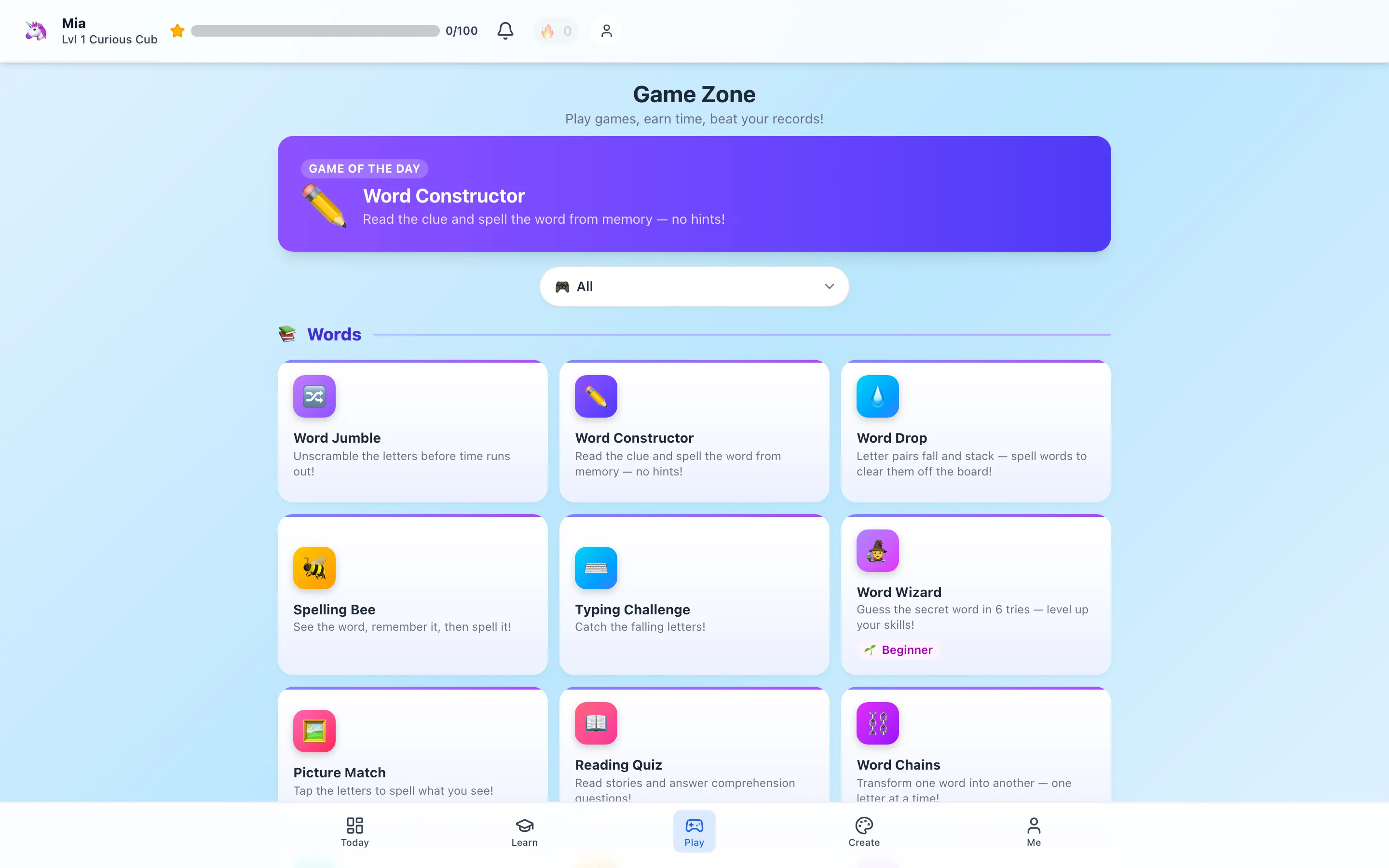
A worksheet awards ten stars. A spelling game asks a child to build words under pressure. A solar-system lab lets them rotate planets, test what they noticed, and try again.
All three may be advertised as “game-based learning.” They are not doing the same job.
The useful distinction is not whether an app has bright colors. It is where the learning sits: inside the decisions that make the game work, or outside the activity in a layer of points and rewards.
Two definitions without the jargon
Game-based learning: the learner has to use the target knowledge or skill to make meaningful progress in the game.
Gamification: an existing task receives game-like elements—points, badges, streaks, levels, leaderboards, prizes, or progress bars.
Imagine a math activity:
- In a game-based version, the child estimates distance, chooses an operation, adjusts a strategy, and sees the outcome change.
- In a gamified version, the child answers a standard multiple-choice problem and receives coins for being correct.
Both can be useful. Only the first makes the mathematical thinking part of play itself.
A six-question parent test
You do not need an education degree to inspect a learning game. Watch a session and ask six questions.
1. What must the child think about to win?
This is the fastest test.
If winning depends on recognizing phonemes, planning a budget, estimating a trajectory, reading a map, or noticing a scientific pattern, the learning is probably inside the game.
If winning depends mainly on tapping quickly, waiting for a reward animation, or tolerating unrelated questions between arcade rounds, the curriculum may be attached rather than integrated.
2. Do choices matter?
Good games create decisions with consequences. The child selects a word, route, tool, quantity, timing, or strategy and receives a result that makes sense.
A four-answer quiz can still teach, especially when explanations are strong. But a quiz with confetti is still a quiz. It should be described honestly rather than treated as proof of game-based design.
3. What happens after a mistake?
Useful feedback connects action and concept. It might replay a sound, show why a structure fell, highlight the part of a word that changed, or let the child revise a plan.
“Wrong—try again” gives less information. Removing a life or streak may add pressure without adding understanding.
4. Does difficulty respond to understanding?
Look for age adaptation, skill progression, varied examples, and another path after repeated difficulty. Endless repetition at one level can create activity without growth.
HomeSchool.You adapts content across four age bands and uses diagnostics and progress signals to inform recommendations. That routing is imperfect like any automated system, so parents can choose something else when the suggestion is wrong.
5. Is there a natural stopping point?
A worthwhile session can end. A round finishes, a lab question is answered, a creation saves, or a parent-set timer expires.
Infinite feeds, autoplay, and rewards that are always one tap away are optimized for continued presence. Learning value does not require that design.
6. Can the child explain or apply anything afterward?
Ask one low-pressure question:
- “How did you know where to aim?”
- “What made that word different?”
- “Why did your bridge hold?”
- “Show me the country you found.”
A child does not need to deliver a lecture. But if nothing from the game can be named, demonstrated, transferred, or used, the educational label deserves scrutiny.
Where rewards can help
Gamification is not automatically manipulative or shallow. A visible path can clarify progress. A badge can mark a real achievement. A short streak can help a family build a routine. Earning bounded play time can make the rules around games predictable.
The key is proportion. Rewards should support the learning loop, not become the only loop.
In HomeSchool.You, children earn XP and can earn arcade minutes through learning. Parents control the daily arcade budget. Educational games, lessons, labs, and creative studios sit outside that arcade timer. There are no ads shown to children and no in-app purchases.
That design still uses gamification. We do not pretend otherwise. The standard is that the reward layer should make progress understandable without making a child feel that learning itself is the toll booth before the “real” fun.
What our 84-game count includes
Product counts can blur categories, so here is the honest breakdown at a high level. HomeSchool.You lists 84 games across word, math, 3D lab, quiz, arcade, brain-training, business, trades, creative, and wellness categories. Some are deeply game-based. Some are structured quizzes or practice activities. A smaller set is straightforward arcade play.
Examples of learning embedded in play include:
- Building and manipulating words
- Solving math under different rules and contexts
- Exploring a 3D science model and answering from observation
- Practicing pattern, memory, mapping, budgeting, or design decisions
- Creating music or visual art with constraints
Quizzes are labeled as quizzes. Arcade games are time-gated as arcade games. Clear categories let a parent decide what role each activity should have.
For a visual example, our 3D science lab walkthrough shows the model, observations, and quiz as separate parts of one experience.
Red flags in any “educational game”
Pause and inspect more closely when:
- The learning question is unrelated to the game mechanics
- Correct answers mostly buy access to non-learning play
- Reward animations take longer than useful feedback
- Difficulty rises through speed alone
- The child can guess repeatedly without consequence or explanation
- A streak creates anxiety about stopping
- There is no parent control over time, spending, or social features
- The product counts every quiz skin as a separate game without explaining the catalog
None of these proves a product is worthless. They tell you what to watch.
Put games in a complete day
Games work best as one mode in a varied rhythm. An upper-elementary day might combine a short math lesson, reading and writing, a science investigation, movement, one independent game block, and creative work. Our realistic three-hour schedule shows what that can look like.
HomeSchool.You also includes 575 activities designed to extend learning into cooking, nature, engineering, art, movement, and local exploration. The screen should sometimes launch the activity and then get out of the way.
The bottom line
Do not ask only, “Does my child enjoy it?” Enjoyment matters, but it is not the whole test. Ask:
- What thinking produces success?
- What does a mistake teach?
- Can the child stop?
- Can they use anything afterward?
A game that passes those questions can be a strong part of homeschool. A reward system can help too, as long as the provider says clearly which one it built.
For category-wide options, see our comparisons of educational games for homeschoolers, apps for children who hate worksheets, and screen time that earns its place. Those are first-party comparison pages, so each one discloses that our product appears in the list.
Editorial note
This first-party guide is published by HomeSchool.You, which offers both educational games and parent-limited arcade games. We use our product as an example because we can verify its mechanics. The same six-question test should be applied to us and to every competing platform.
Frequently asked questions
What is the difference between game-based learning and gamification?
In game-based learning, understanding is part of how the player succeeds inside the game. Gamification adds rewards such as points, badges, streaks, or levels around an activity that could otherwise remain unchanged.
Is gamification bad for children?
Not automatically. A progress bar or badge can make practice clearer and more motivating. The problem is when rewards become the only reason to continue or hide weak learning underneath.
Are all HomeSchool.You games educational?
The catalog includes educational games, quizzes, creative tools, 3D labs, and a smaller arcade category. Arcade games use a parent-set daily time budget; educational activities do not consume that budget.
How can a parent judge whether a learning game is worthwhile?
Watch what the child must think about to win, whether difficulty responds to understanding, whether mistakes produce useful feedback, and whether the child can explain or apply anything afterward.
Should games replace direct teaching and hands-on work?
No. Games are one learning mode. Children also need conversation, reading, explanation, writing, physical activity, creative work, and targeted human support.