Best Educational Games for Homeschoolers in 2026
Trial offer update — September 17, 2026: HomeSchool.You's Summer Welcome Special offered a 7-day free trial with no credit card required, valid through September 15, 2026. That special is no longer active. New standard signups now receive a 3-day free trial with a credit card required upfront. The selected plan bills automatically when the trial ends unless canceled beforehand. Existing users keep their already-promised trial terms. See current plans and trial terms.
Disclosure: we make HomeSchool.You, which appears below. Two free options are ranked above several paid ones, including ours in some categories.
First, a distinction worth understanding before you buy anything.
Two kinds of "educational game"
Reward-loop games attach practice to a game economy — answer questions, earn coins, win battles. Prodigy is the best example. The learning is a standard question set; the game is motivation. This works, and it works well: children voluntarily do far more practice than they otherwise would.
Mechanic-as-lesson games make the skill the thing you do. A physics lab where you change the variables and watch what happens. A word game where the constraint is the phonics rule. These teach more directly but are harder to build and rarer.
Neither is better in the abstract. If your child refuses practice, a reward loop solves your actual problem. If your child practices willingly but doesn't understand, the second kind helps more.
Comparison
| Platform | Price | Ages | Type |
|---|---|---|---|
| Prodigy | Free core; ~$5–$20/mo | ~5–14 | Reward loop |
| Khan Academy Kids | Free | 2–8 | Guided play |
| HomeSchool.You | $20/mo, up to 4 children | 3–10 | Mixed, 84 games |
| Adventure Academy | $12.99/mo or $45/yr | 8–13 | MMO reward world |
| SplashLearn | ~$11.99/mo | PreK–5 | Structured game practice |
| ABCmouse | $45/year | 2–8 | Guided play + games |
| Beast Academy | $15/mo or $96/yr | 6–13 | Problem-solving comics |
Prices verified against published company pages, August 2026.
Best free math game: Prodigy
Core math and English free; memberships roughly $5–$20/month. Math covers PreK–8. The fantasy RPG format is the most effective motivational design in this category — children who refuse worksheets will do hundreds of problems to win fights.
The trade-off: membership perks are visible to non-paying children during play, which some parents dislike. Full comparison.
Best free for young children: Khan Academy Kids
Free, ad-free, nonprofit, ages 2–8. No upselling of any kind, gentle pacing, strong early literacy. Nothing to buy, ever. Full comparison.
Widest game range: HomeSchool.You
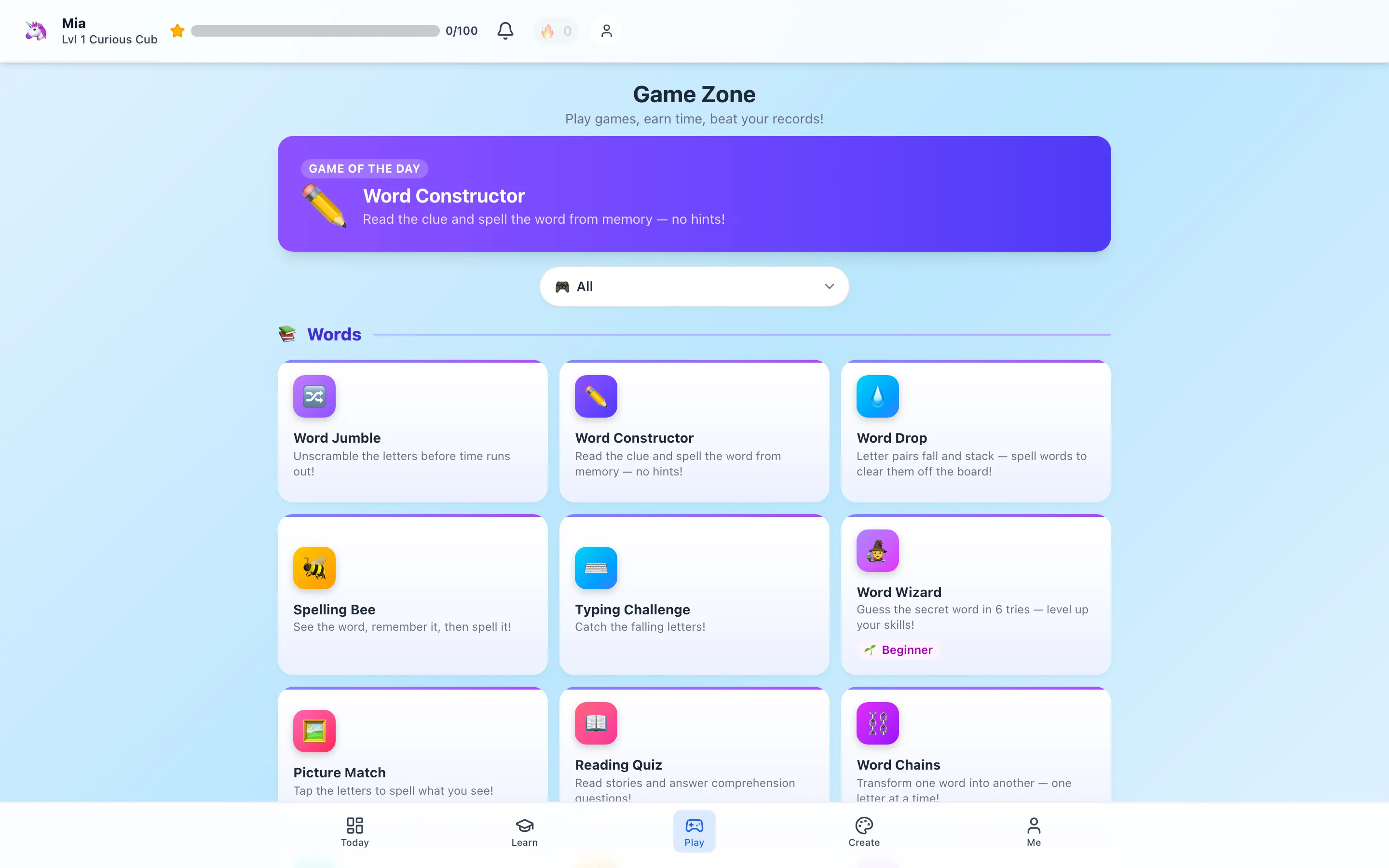
$20/month for up to four children ages 3–10, with 84 games across words, math, 3D science labs, quizzes, arcade, and brain training — plus 57 courses and 575 hands-on activities.
The platform exists to solve one problem: making screen time you don't feel guilty about. The realistic comparison for most parents isn't a game versus a nature walk — it's a game versus YouTube, at the point in the day when you need twenty minutes.
The design decision we'd point to: arcade-style games are time-gated against a daily budget parents set, while educational games are not. Children earn arcade time by learning rather than the reverse. There's also no advertising and nothing to buy inside the product. What we don't do: reach past age 10, or match Prodigy's math depth. See our learning games overview.
Best social game world: Adventure Academy
$12.99/month or $45/year, ages 8–13, from Age of Learning. A shared multiplayer world covering four core subjects, with no ads and no in-game purchases.
Whether the multiplayer element is a feature or a concern is a family decision — it's a moderated space, but it is a space with other children in it. Full comparison.
Best structured game practice: SplashLearn
About $11.99/month for math and reading. Math PreK–grade 5 with careful sequencing; reading stops at grade 2. Free tier available and free for teachers. Full comparison.
Best for preschool: ABCmouse
$45/year, ages 2–8, 30-day trial, up to 3 profiles. Games embedded in a guided learning path, well-tuned for pre-readers. Full comparison.
Best for strong math students: Beast Academy
$15/month or $96/year, ages 6–13, from Art of Problem Solving. Genuinely difficult problem solving delivered as comics — the answer for a child who finds other math games too easy. Not for a child who's behind.
How to pick
- Child refuses math practice → Prodigy, free
- Budget is zero → Prodigy or Khan Academy Kids
- You want games across many subjects → HomeSchool.You
- Child is 11–13 → Adventure Academy or Prodigy
- Child is ahead in math → Beast Academy
- Screen time is the worry → look for time controls, not just content
A practical note: the most common mistake is buying a game platform to fix a comprehension problem. Games are excellent at increasing willingness. If a child understands the material but won't practice, that's the right tool. If they're practicing and still not getting it, you need instruction — from a curriculum or a teacher — not a better game.
Our 3-day trial requires a credit card upfront.
Methodology
Prices come from each company's published pages in August 2026. We put two free platforms above our own paid product in their categories, because for the specific jobs they do, they're the better choice.
Frequently asked questions
Do educational games actually work?
It depends on the design. Games where the mechanic itself requires the skill teach well. Games that wrap a standard quiz in a reward loop mainly increase how much practice a child is willing to do — which is still valuable, just different.
What's the best free educational game?
Prodigy's core math and English content is free, and Khan Academy Kids is entirely free for ages 2–8 with no ads.
How do I stop educational games becoming just screen time?
Look for platforms with time controls. HomeSchool.You time-gates arcade-style games against a parent-set daily budget while leaving educational games ungated, so play is earned.
Are educational games really better than YouTube?
For most of them, yes — and that's the comparison that actually matters. Parents are rarely choosing between a game and a nature walk; they're choosing between a game and autoplay video at 5pm. A game that has your child solving problems clears that bar easily.
What's best for a child aged 11–13?
Adventure Academy covers 8–13, and Prodigy's math reaches 8th grade. Most game-based platforms stop before then.
Are there educational games without other players online?
Yes. HomeSchool.You, SplashLearn, Prodigy, and Khan Academy Kids have no open multiplayer world. Adventure Academy does.
Which covers the most subjects through games?
HomeSchool.You has 84 games spanning words, math, 3D science labs, quizzes, and brain training. We publish this list, so weigh that.