10 Languages, 8 Stages, and 7 Game Modes: How HomeSchool.You Language Learning Works
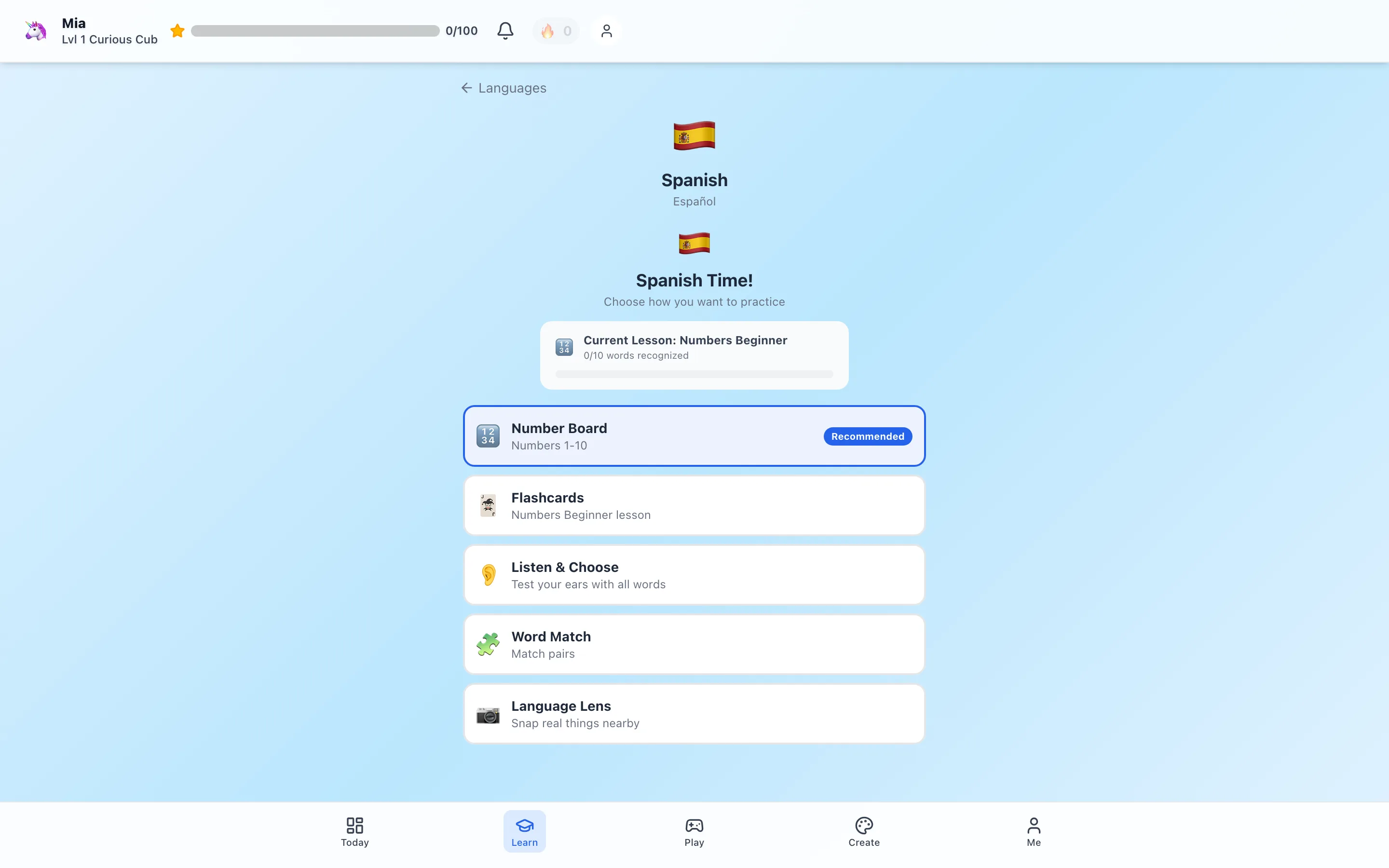
HomeSchool.You includes 10 language programs, but the useful question is not the count. It is what happens after a child taps “Spanish”—and whether the experience is honest about the difference between early exposure and fluency.
The short answer: children move through an eight-stage vocabulary path and practice with seven modes that shift from seeing and hearing to recall, matching, conversation, and checkpoint review.
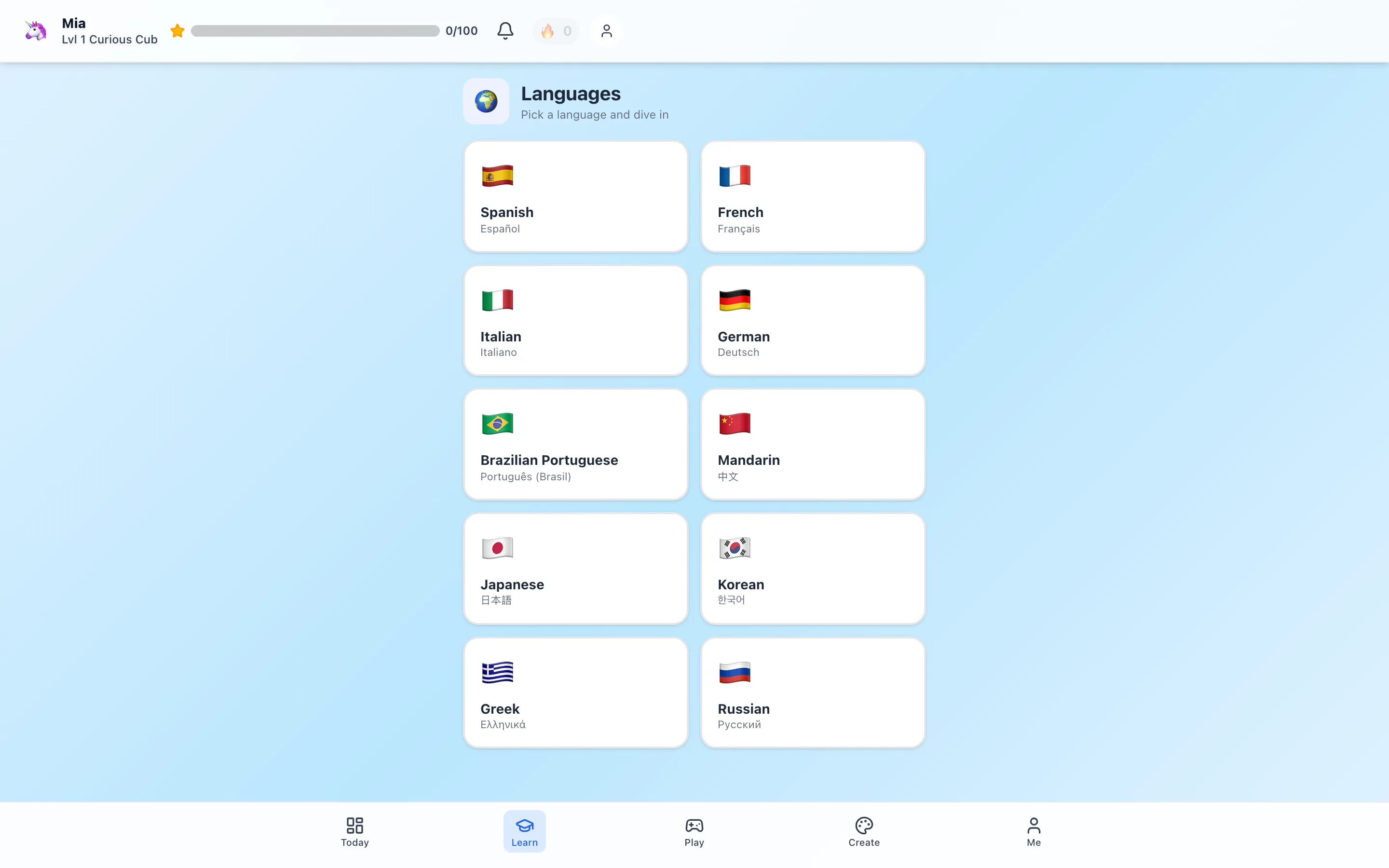
The 10 languages
The current programs are:
- Spanish
- French
- German
- Italian
- Portuguese
- Mandarin
- Japanese
- Korean
- Greek
- Russian
All ten are included inside the same family subscription. They are not separate paid packs.
The eight-stage learning path
| Stage | Product label | What it adds |
|---|---|---|
| 1 | Numbers I | Ordered numbers and the first repeatable sound-to-meaning set |
| 2 | Colors | Concrete visual vocabulary |
| 3 | Greetings | Social words and the beginning of conversation mode |
| 4 | Travel Ready | Practical food, direction, shopping, feeling, and manners phrases |
| 5 | Theme Words | Vocabulary connected to the current learning theme |
| 6 | Numbers II | A larger number range and retrieval practice |
| 7 | Vocab Builder | Review and expansion across theme vocabulary |
| 8 | Language Star | Cross-theme review that asks the learner to connect earlier work |
Stages unlock in order, and checkpoints gate progression. That provides more structure than an open pile of flashcards while keeping sessions small.
The seven practice modes
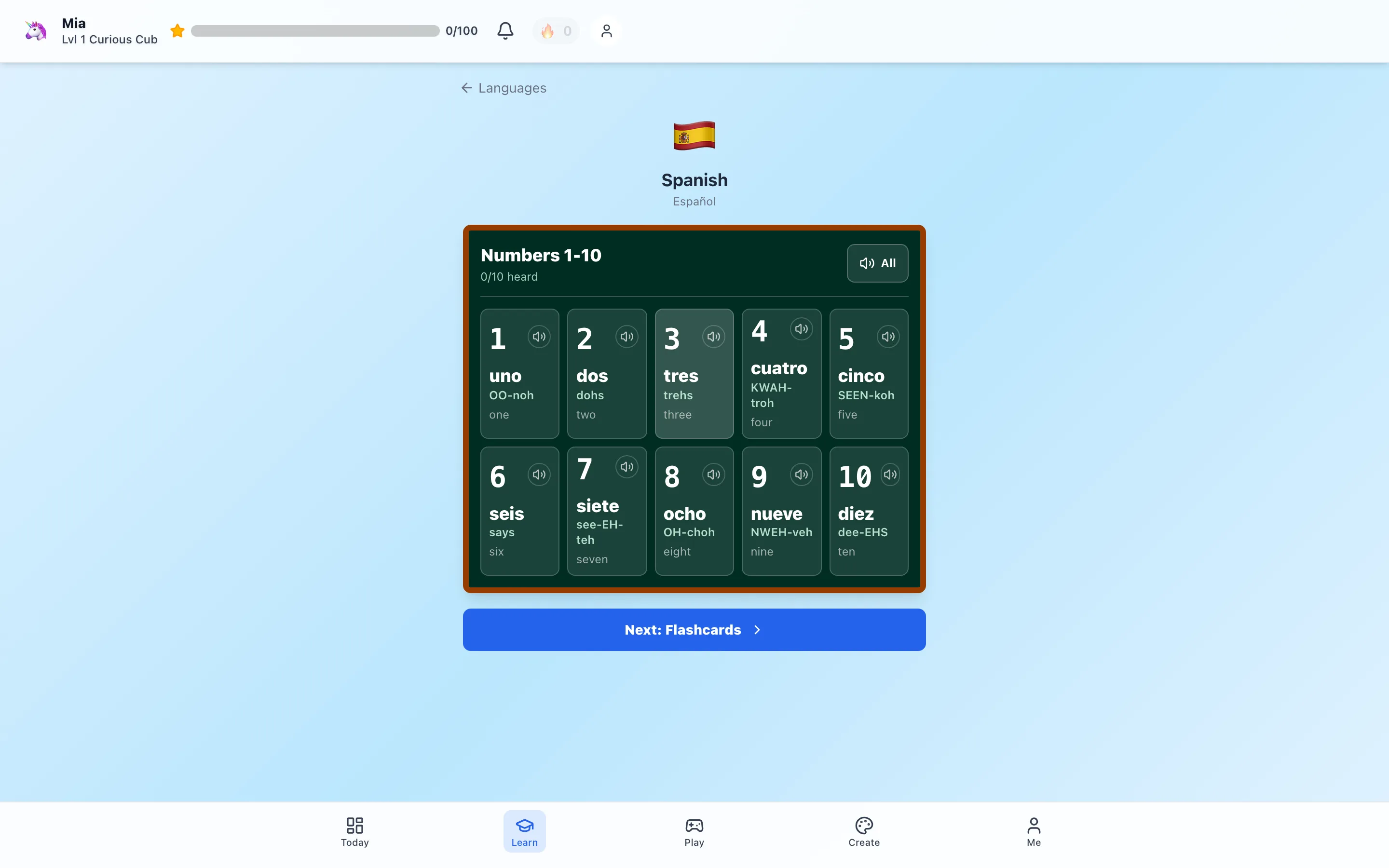
1. Number Board
Numbers appear in order with the numeral, target-language word, English meaning, a phonetic hint where supplied, and a button to hear the word. This is the easiest entry for a pre-reader because the pattern is predictable.
2. Learn Words flashcards
Flashcards introduce and review the current stage’s vocabulary. Audio makes the mode usable before independent reading, though a parent should listen too and model rather than treat generated or recorded audio as a complete pronunciation teacher.
3. Listen Up
The child hears a word and chooses the match. Removing the written prompt shifts the task from visual recognition to listening discrimination.
4. Word Match
The child pairs target-language and English words from memory. Matching can reveal recognition, but the child should also say the word aloud or use it in context.
5. Talk It Out
Conversation practice unlocks with Greetings. It uses short exchanges and practical phrases. This is rehearsal, not a live conversation with a fluent speaker.
6. Stage Checkpoint
A checkpoint samples the stage before opening the next one. It is a progression gate and practice signal—not a proficiency certification.
7. Language Lens
The parent-controlled camera or photo tool connects vocabulary to objects in the room. A manual fallback is available when camera use is unavailable or unwanted. The feature should be used with a parent’s awareness because it involves the device camera.
What changes by age
The product is designed for ages 3–10:
- Pre-K: picture, sound, repetition, gesture, and a parent beside the child
- Kindergarten: sound plus early word recognition and small matching sets
- Early elementary: larger sets, reading support, retrieval, and short exchanges
- Upper elementary: broader vocabulary, phrases, cross-theme review, and more self-monitoring
Not every child will fit the default band. A bilingual 5-year-old may need more challenge than a first-time 9-year-old. The profile age is a starting point, not a proficiency placement test.
How much content is in each language?
The canonical pack structure includes 178 or more phrase and vocabulary entries per language before counting every themed expansion: greetings, numbers, colors, travel phrases, and theme vocabulary. Theme packs connect language work to animals, space, food, nature, transportation, family, weather, and other areas of the platform.
More entries do not automatically mean better learning. The useful design question is whether a child meets the same word through multiple channels and retrieves it over time. The seven modes are intended to create that repetition without making every round identical.
A 12-minute language session
- Tap the Number Board or Learn Words for 3 minutes.
- Say each word aloud and point to or act out the meaning.
- Use Listen Up or Word Match for 4 minutes.
- Use one word in a tiny real exchange: “I see blue,” “two apples,” or “thank you.”
- Stop and revisit tomorrow.
Short, repeated encounters are more realistic for young children than a long grammar block.
What the program does not claim
HomeSchool.You language learning is early exposure and structured practice. It does not provide:
- A live fluent teacher or conversation partner
- Formal grammar instruction at an adult-course depth
- A standardized proficiency rating
- A guarantee of native-like pronunciation or fluency
- Full bilingual curriculum immersion
Families pursuing bilingualism should add real conversation, books, songs, community experiences, and fluent speakers whenever possible.
Where language fits in the wider curriculum
Language practice sits beside the 20-lesson World Language Foundations syllabus, geography and culture work, recipes, maps, and hands-on activities. The course teaches language-learning habits and cultural respect; the ten packs supply target-language practice.
For real screenshots of the Spanish path, see the Spanish lesson walkthrough. To judge the broader lesson structure before signup, open the sample lesson library and the public learning-quality standard.
Frequently asked questions
Which 10 languages are included?
Spanish, French, German, Italian, Portuguese, Mandarin, Japanese, Korean, Greek, and Russian.
What are the eight curriculum stages?
Numbers I, Colors, Greetings, Travel Ready, Theme Words, Numbers II, Vocab Builder, and Language Star cross-theme review.
What are the seven practice modes?
Number Board, Learn Words flashcards, Listen Up, Word Match, Talk It Out, stage checkpoints, and the parent-controlled camera or photo Language Lens with manual fallback.
Will this make a child fluent?
No. It is early vocabulary, listening, pronunciation, recognition, and simple-conversation practice for ages 3–10. Fluency requires sustained input, interaction, feedback, and broader reading and cultural experience.
Are languages sold separately?
No. All 10 are included in the complete family platform rather than sold as separate add-ons.