Microschool Curriculum for Up to 8 Students (2026)
Trial offer update — September 17, 2026: HomeSchool.You's Summer Welcome Special offered a 7-day free trial with no credit card required, valid through September 15, 2026. That special is no longer active. New standard signups now receive a 3-day free trial with a credit card required upfront. The selected plan bills automatically when the trial ends unless canceled beforehand. Existing users keep their already-promised trial terms. See current plans and trial terms.
Disclosure: HomeSchool.You publishes this guide, and Academy is our product. The goal here is to separate what the eight-seat plan can do today from features that are still planned.
A microschool with eight students has a different software problem from a family with one child. Content matters, but so do seat limits, separate progress records, adult oversight, and a price that does not multiply eight times.
HomeSchool.You Academy costs $35/month or $299/year for up to eight learner profiles. It is built for ages 3-10 and can be used by a microschool, learning pod, tutoring practice, or home daycare. All eight learners use the full platform while keeping their progress separate.
What works today for an eight-learner group
The current Academy plan includes:
- up to eight individual learner profiles
- one shared, all-kids dashboard
- separate progress reports for each learner
- per-child adaptations across 65 support patterns
- advanced group and family analytics
- sibling or group competitions and leaderboards
- compliance tracking and filing support
- the full learning catalog for every seat
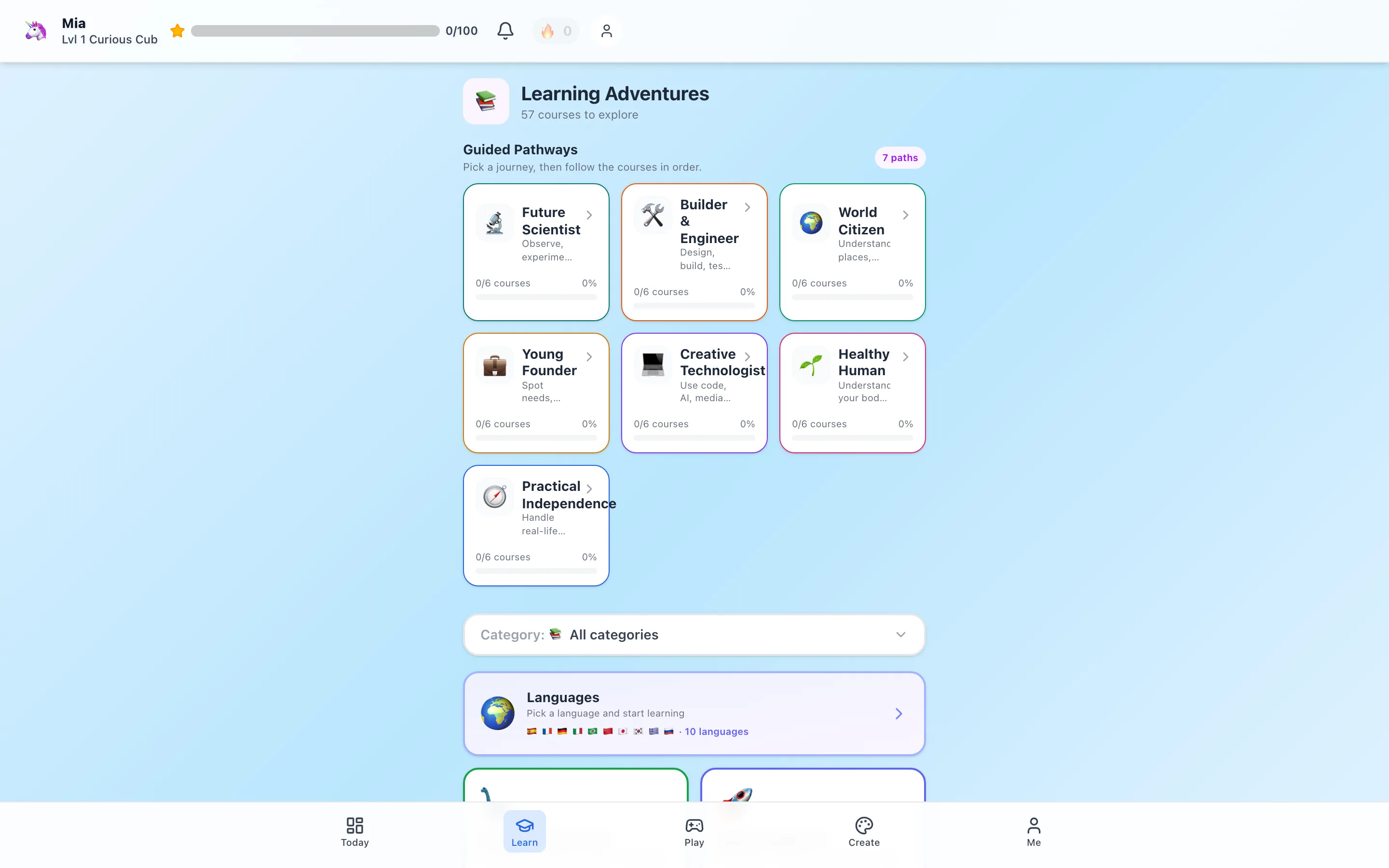
That last point matters. A seat is not limited to a subject bundle. Each learner can use 57 launch-visible courses across 14 subjects, 84 games, 575 hands-on activities, all 10 language programs, 541 U.S. park virtual field trips, and the art and music studios.
The eight-seat cost
| Billing option | Total cost | Cost per learner at 8 seats | Monthly equivalent per learner |
|---|---|---|---|
| Monthly | $35/month | $4.38/month | $4.38 |
| Annual | $299/year | $37.38/year | $3.11 |
Paying annually saves $121 compared with twelve monthly payments. At full use, the annual plan puts the curriculum cost at about $3.11 per learner per month.
Cost per seat is not the whole decision, though. A cheap platform that cannot separate progress creates manual work elsewhere. The useful question is whether one adult can see who completed what without maintaining a parallel spreadsheet.
A realistic day in a small learning group
Academy works best when learners do not all need the same lesson at the same moment.
One child might work through reading, another might use a 3D science lab, and two others might practice different languages. Because their profiles are separate, the adult can review progress by learner afterward instead of treating the group like one account.
The 575 hands-on activities also make it possible to move part of the group away from screens—into a cooking task, nature activity, engineering build, or scavenger hunt—while others finish an individual lesson. The platform supplies the activity; the educator still chooses the grouping and supervises it.
For a closer look at the content rather than the seat model, see what a Spanish lesson looks like and what happens inside a 3D science lab.
What Academy does not include today
This is where buyers should be careful with any “microschool software” claim. Academy is an eight-learner curriculum and coordination plan, not a full school administration suite.
The current plan does not promise:
- a separate parent portal for every family
- bulk roster import
- branded progress-report PDFs
- 20 or more student seats
- middle-school or high-school curriculum
Parent portal invitations, branded PDFs, bulk roster import, expanded cohort analytics, and 20 seats are planned for a future Educator Pro tier. They should not be part of a decision to buy Academy today.
Co-op invite links and bulk scheduling are also listed as coming soon. If either is essential to how your group operates, wait for it or use a separate communication and scheduling tool rather than assuming it is already live.
Academy versus a collection of individual subscriptions
Buying separate accounts can make sense when each student needs a different specialist product. A strong dyslexia intervention for one child or a live math class for another may be worth paying for individually.
Academy makes more sense when most of the group needs the same broad ages 3-10 environment and the adult wants one place to coordinate it. Its advantage is the combination:
- one subscription rather than eight renewals
- one content library rather than eight separate purchases
- individual learner state rather than one shared progress bar
- one adult dashboard rather than eight unrelated accounts
For a household rather than a learning group, read the large-family Academy cost breakdown. The same eight-seat price applies, but the buying decision is simpler because one parent controls every profile.
Who should choose it
Academy is a practical fit when all four statements are true:
- You serve no more than eight active learners.
- Most or all learners are ages 3-10.
- You want broad digital and hands-on content rather than one specialist subject.
- A shared adult dashboard and individual progress reports cover your current administrative needs.
If you need parent portals, bulk enrollment, transcripts, or secondary-school coverage now, choose a system that ships those capabilities now. If eight younger learners and one coordinated dashboard describe your group, review the current feature list on the Academy pricing page and test the workflow during the three-day trial.
Methodology
Pricing and included features were checked against the Academy plan configuration and public pricing page on August 28, 2026. Per-learner figures divide the public plan price by eight and round to the nearest cent. Features labeled “coming soon” are excluded from the current-capability list.
Frequently asked questions
How many students does HomeSchool.You Academy support?
Academy includes up to eight learner profiles for $35 per month or $299 per year.
Can a microschool use Academy today?
Yes. A microschool, learning pod, tutoring practice, or home daycare can track up to eight learners with a shared dashboard, separate progress reports, and compliance tools.
Does each student have separate progress tracking?
Yes. Each learner has an individual profile, progress record, and learner adaptations while the adult manages the group from one dashboard.
Does Academy include all ten language programs for every student?
Yes. All ten language programs are included for every Academy learner, along with the full course catalog, games, hands-on activities, field trips, and creative studios.
Does Academy have parent portals and bulk roster import?
Not in the current eight-seat plan. Parent portal invitations, bulk roster import, branded PDFs, and expanded cohort analytics are planned for the future Educator Pro tier, not promised as current Academy features.
What ages does the microschool curriculum cover?
HomeSchool.You is built for ages 3-10. Groups serving middle school or high school students will need another curriculum for those learners.