What a Real HomeSchool.You Learning Block Includes: Facts, Quiz, Activity, and Four Age Levels
“1,000+ lessons” sounds impressive, but the count tells you almost nothing about what a child will actually experience. A lesson could be a two-minute slideshow, a long video, a worksheet PDF, or a carefully adapted sequence.
Here is the exact structure HomeSchool.You uses—and one important correction to our own shorthand: a course lesson and a hands-on activity are separate content records. A daily learning block can pair them, but we should not imply every lesson file contains an experiment.
The five parts of a useful learning block
| Part | What HomeSchool.You stores | What a parent should look for |
|---|---|---|
| Instruction | Short fact sets by age band | Accurate, understandable ideas—not just colorful decoration |
| Check | Quiz questions by age band | A question that matches what was taught |
| Application | A related hands-on activity | Real instructions, materials, duration, and safety needs |
| Output | An artifact prompt where authored, or a parent-added explain/make step | Something the child can show, say, draw, build, or write |
| Record | Completion and progress data | A useful clue, not automatic proof of mastery |
Part 1: facts change across four age levels
Each course lesson can hold a different fact set for:
- Pre-K (roughly ages 3–4)
- Kindergarten (roughly ages 5–6)
- Early elementary (roughly ages 6–8)
- Upper elementary (roughly ages 8–10)
The public Counting Things You Can See sample shows all four records side by side. The Cells: Building Blocks of Life sample does the same for science.
The quality test is not whether four tabs exist. It is whether the language, detail, reasoning, and independence expectations actually change. A Pre-K fact should not be an upper-elementary paragraph with one hard word removed.
Part 2: the quiz should match the instruction
Every course lesson contains questions for each age band. A quiz can check recall, reasoning, comparison, or reflection. Some questions include a follow-up prompt.
We deliberately omit the correct answer from public sample pages, so a family can use the prompt as a real preview. Inside the product, the child gets immediate feedback and an explanation.
There are two honest limits:
- A multiple-choice answer can show recognition without proving that a child could explain the idea independently.
- A single score is not a diagnosis, grade, or durable mastery measure.
Use the result to decide what to revisit. Then ask the child to explain, demonstrate, or apply the idea.
Part 3: hands-on application is a separate activity
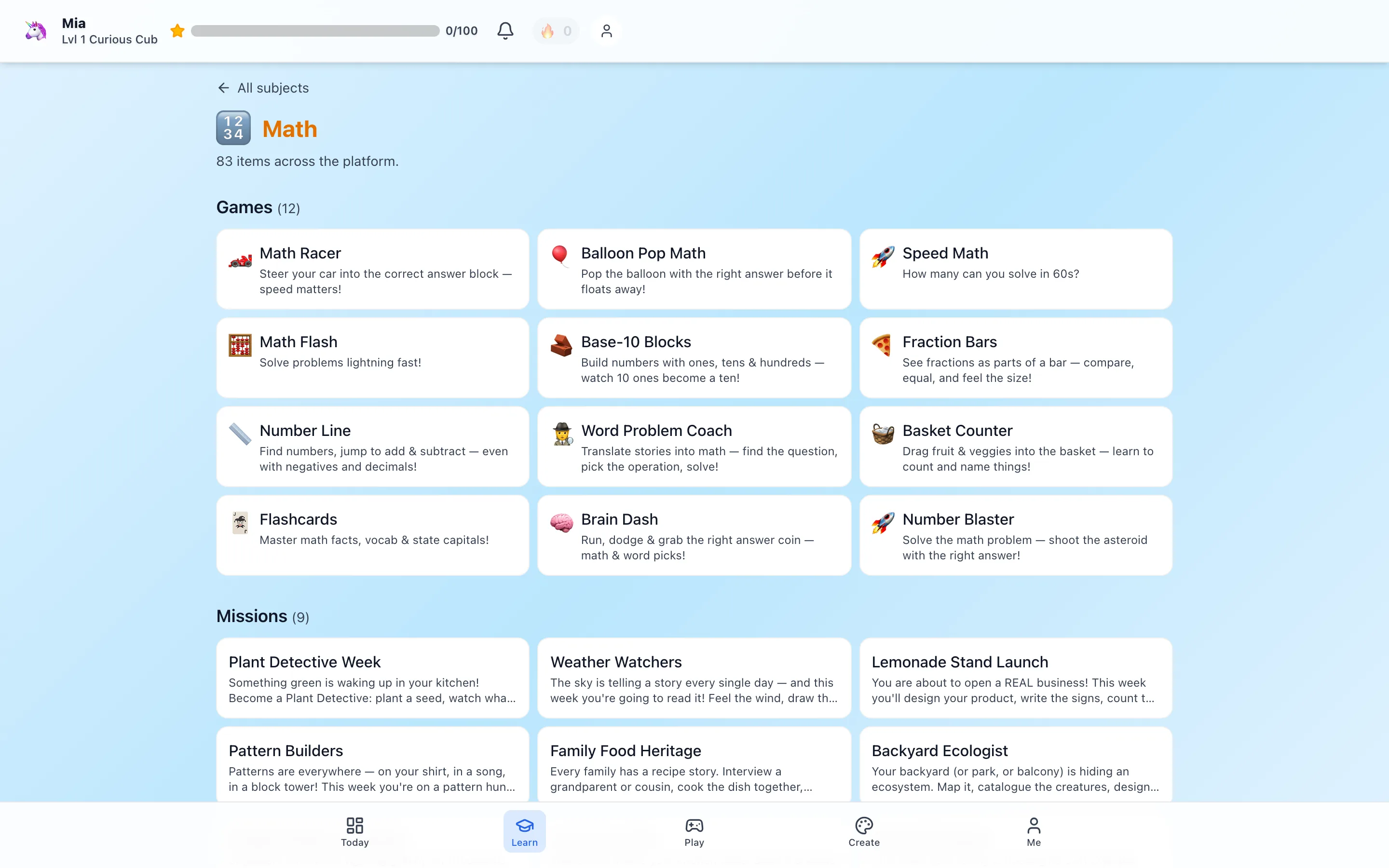
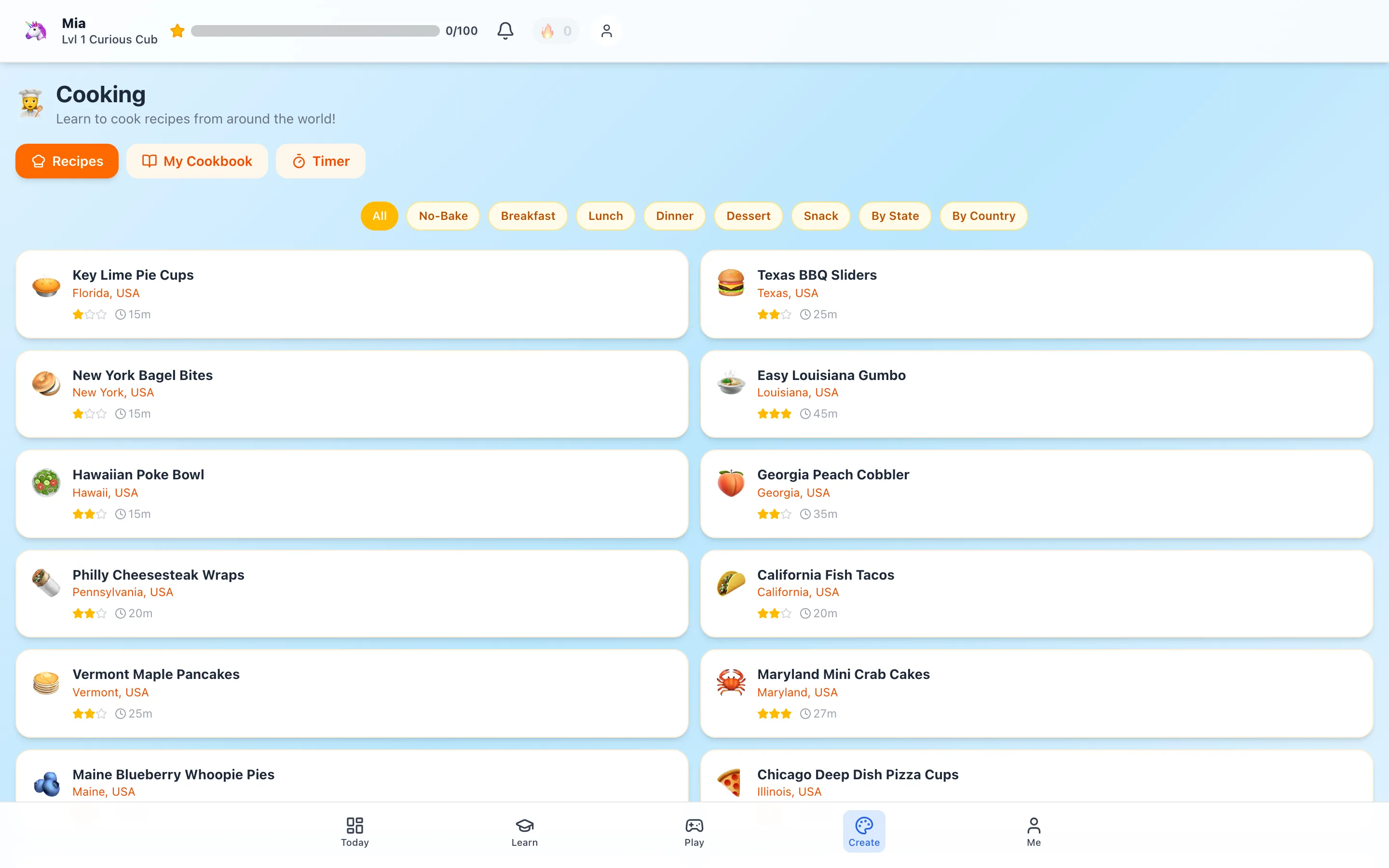
HomeSchool.You currently has 575 activities. Each record can include materials, duration, format, parent involvement, screen-time status, and four age-level versions with their own steps and learning objectives.
That separation is useful. A course can explain weather; the family can then choose Weather Station Builder, Shadow Tracing, or Weather Journal based on time and materials.
An activity completion is still not the whole story. Ask what changed, why the result happened, or what the child would do differently next time.
Part 4: make-or-explain prompts create better evidence
Some course lessons have an artifactPrompt: a short request to draw, write, build, record, photograph, demonstrate, or reflect. For example, a language lesson may ask for a four-turn conversation; a kitchen-safety lesson may ask the child to create or demonstrate a safety routine.
Where an artifact prompt is not yet present, a parent can add one sentence:
- “Draw the idea and label two parts.”
- “Teach this back to me without looking.”
- “Build a model from things in the recycling bin.”
- “Show me one example and one non-example.”
- “Take a photo and tell me what it proves.”
These outputs are more informative than another badge because they expose the child’s reasoning.
Part 5: parent-visible progress is a summary, not a verdict
The platform can record course and activity completion and organize that history into parent tools. It can help generate attendance, progress, annual-report, portfolio, and transcript-style parent records.
It cannot know everything that happened off-platform. It also cannot turn a click into an accredited grade. Parents should review, annotate, and add outside reading, projects, field trips, and observations.
A real 30-minute example
Here is one possible kindergarten math block:
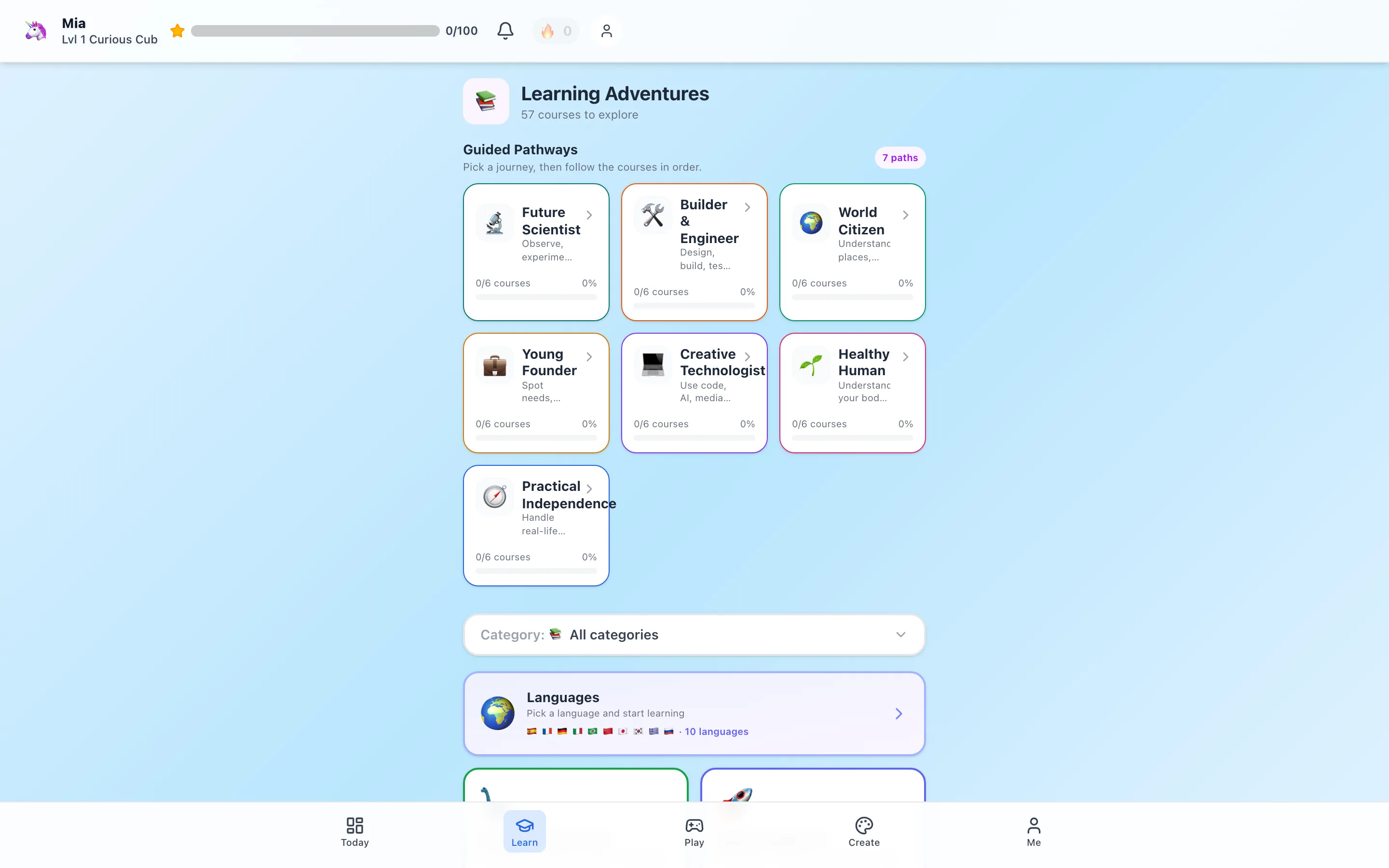
- 7 minutes: use the age-level facts and question in Counting Things You Can See.
- 12 minutes: do the kindergarten version of Counting Collections with real objects.
- 5 minutes: play Basket Counter or Base-10 Blocks.
- 6 minutes: ask the child to draw the groups and explain how they counted.
The exact timing will vary. The important pattern is learn → check → do → explain, with a clear endpoint.
How we audit the content
Product counts come from a canonical repository record. The public course and activity pages are generated from current app data. Lesson records support fact-level source URLs; public samples display those links where they exist.
Source coverage is not universal, and the platform does not claim an independent efficacy study or universal educator approval. Those limits—and the correction route—are documented in the public learning-quality standard.
Inspect before you trust
Start with the 16 sample lessons. Pick two age bands and compare them. Then open one of the 57 full syllabi and one detailed activity record.
That is the evidence we would want before another product asked us to believe a four-digit lesson count.
Frequently asked questions
Does every HomeSchool.You lesson include a hands-on activity inside the same lesson record?
No. Course lessons contain age-banded facts and quiz questions, and some include an artifact prompt. Hands-on activities are separate records that can be paired with the topic in a daily learning block. We keep that distinction explicit.
How many age versions does the content have?
Course lessons and activities support four age bands—Pre-K, kindergarten, early elementary, and upper elementary—with separate content records rather than only a visual label.
Are quiz scores proof of mastery?
No. A quiz is a check for understanding and a practice signal. A child's explanation, demonstration, project, or work sample supplies stronger evidence.
Can parents inspect lesson examples before signup?
Yes. The public sample library exposes 16 representative lessons across four age bands, with facts, a quiz prompt, source links where attached, and artifact prompts where present.