Inside the Animal Kingdom Lab: Photoreal 3D Animals, Real Zoology, and a Quiz That Checks Understanding
Trial offer update — September 17, 2026: HomeSchool.You's Summer Welcome Special offered a 7-day free trial with no credit card required, valid through September 15, 2026. That special is no longer active. New standard signups now receive a 3-day free trial with a credit card required upfront. The selected plan bills automatically when the trial ends unless canceled beforehand. Existing users keep their already-promised trial terms. See current plans and trial terms.
This is the second stop in our screenshot series (the Solar System Lab walkthrough came first). Same rules: every image below is a real, unedited capture of the HomeSchool.You Animal Kingdom Lab running in a normal browser — exactly what a child sees.
A photoreal elephant you can walk around
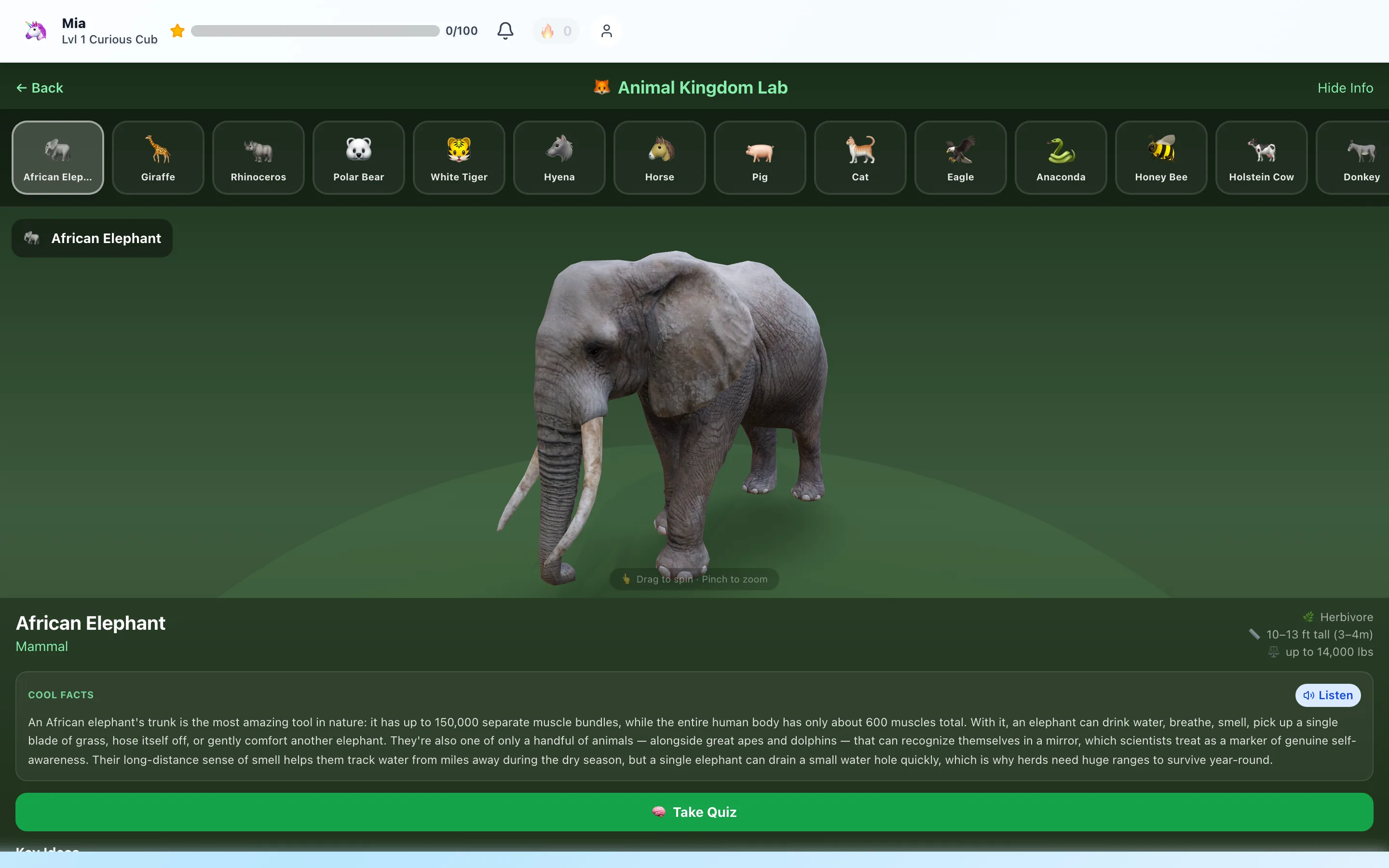
The lab opens on an African elephant — not a cartoon, a detailed 3D model with wrinkled hide and worn tusks that a child drags to spin and pinches to zoom. The animal rail along the top holds the rest of the menagerie: giraffe, rhinoceros, polar bear, white tiger, hyena, eagle, anaconda, honey bee, and the farm crew (horse, pig, cat, cow, donkey).
The Cool Facts panel underneath doesn't do "elephants are big." It tells the child that a trunk contains up to 150,000 separate muscle bundles while an entire human body has about 600 muscles — and that elephants are one of the only animals besides great apes and dolphins that recognize themselves in a mirror. The stat card gives the numbers kids repeat at dinner: herbivore, 10–13 feet tall, up to 14,000 lbs. Non-readers tap Listen and hear it narrated.
The white tiger entry teaches genetics without saying "genetics lesson"
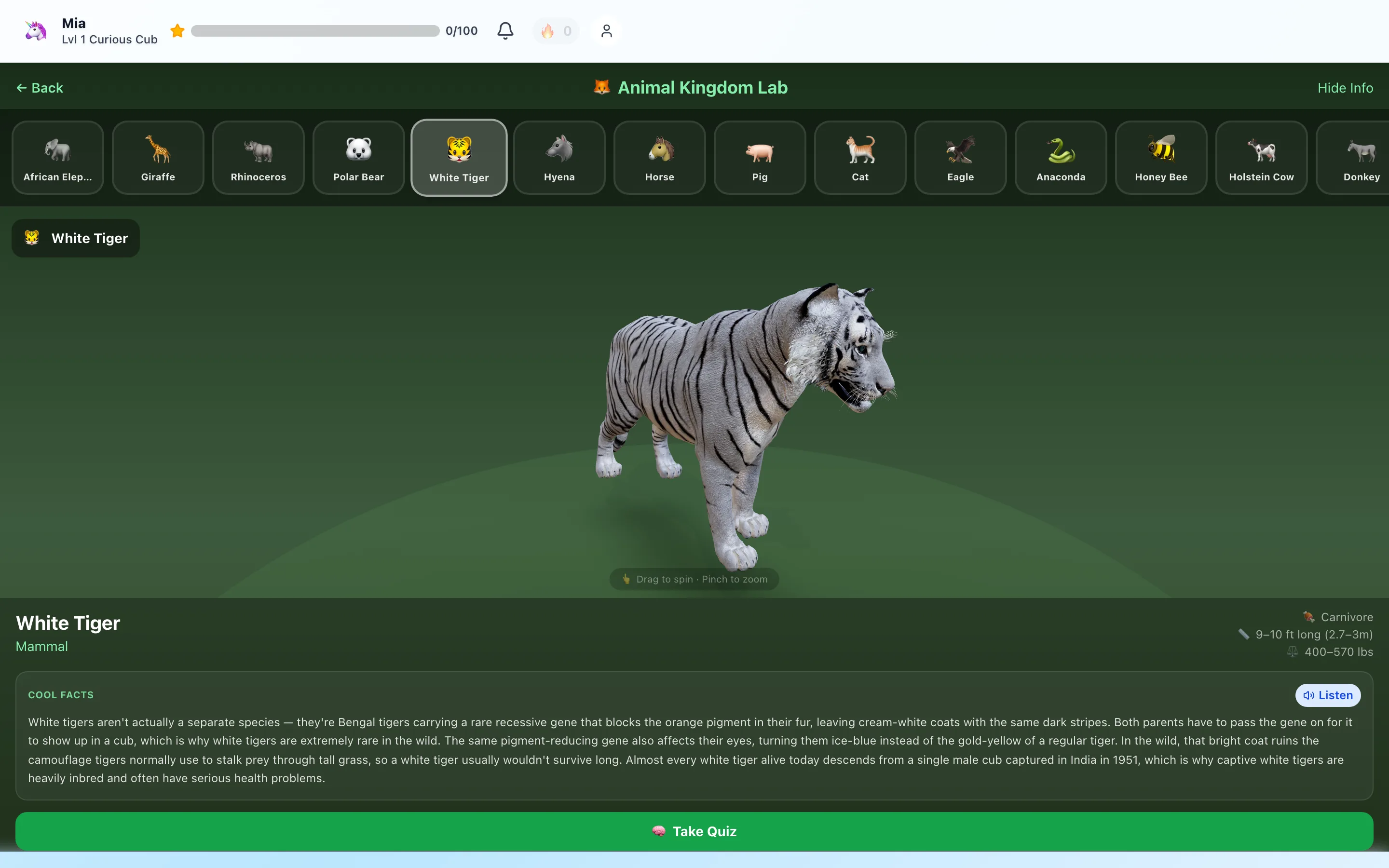
Tap the White Tiger and the fact panel quietly delivers a real genetics and conservation lesson: white tigers aren't a species — they're Bengal tigers carrying a rare recessive gene that blocks orange pigment, and both parents must pass it on for a white cub. The same gene turns their eyes ice-blue. Then the honest part most kids' content skips: the white coat ruins hunting camouflage, so white tigers rarely survive in the wild, and nearly every captive one descends from a single cub captured in India in 1951 — which is why they're often inbred and unhealthy.
That's recessive inheritance, natural selection, and an animal-welfare question in one paragraph a seven-year-old will actually read, because there's a tiger they can spin right above it.
Then the quiz checks whether it stuck

Take Quiz opens three questions on this animal only. "What color are a white tiger's eyes?" is answerable precisely because the fact panel explained why the eyes are blue (the same pigment-blocking gene) — the quiz rewards reading for mechanism, not keyword spotting. Wrong options are plausible (yellow-gold is a normal tiger's eye color), so guessing is hard but recall is easy.
Questions tier by age band — siblings sharing the lab get different difficulty — and passing earns coins and a mastered badge on the child's progress page.
The same pattern, ten labs deep
Animal Kingdom is one of 10 interactive 3D labs on HomeSchool.You — solar system, ocean life, spacecraft, telescopes, botany, Mars missions, mythology, transport, and construction follow the same model → facts → quiz loop. All included in the flat $20/month family plan (up to 4 children), all in the offline packs, all inside the 3-day free trial that requires a credit card upfront.
Frequently asked questions
What animals are in the HomeSchool.You Animal Kingdom Lab?
A mix of wild and farm animals as interactive 3D models — African elephant, giraffe, rhinoceros, polar bear, white tiger, hyena, horse, pig, cat, eagle, anaconda, honey bee, Holstein cow, donkey, and more. Each has its own narrated fact panel, stat card, and quiz.
Are the animal models realistic or cartoon-style?
Photorealistic. The lab uses detailed 3D models (the white tiger has visible fur striping and musculature) rather than cartoon art, because a child studying a rhinoceros should see what a rhinoceros actually looks like from every angle.
Is the zoology accurate enough to count as science learning?
The fact panels are written to be true and specific — the white tiger entry, for example, explains recessive inheritance (both parents must carry the pigment-blocking gene), why the trait is rare in the wild, and the conservation problem of captive inbreeding. Facts go through a fact-check pass against primary sources before shipping.
What happens after my child reads about an animal?
A Take Quiz button under each animal opens a short age-tiered quiz on that animal only. Passing earns coins and marks the animal mastered on the child's progress page, so parents see evidence of learning rather than just time spent.