Khan Academy Kids vs HomeSchool.You — An Honest Comparison (2026)
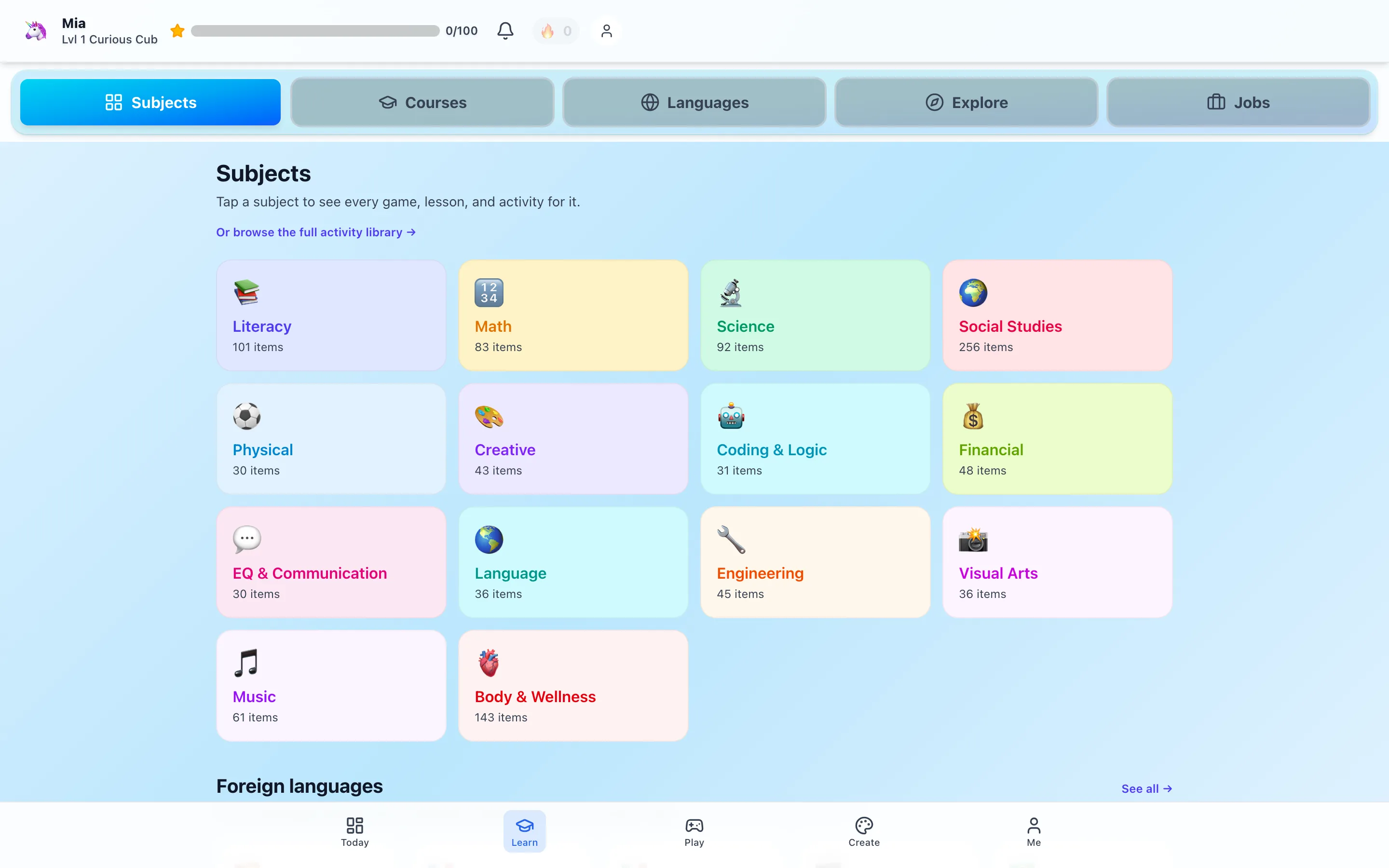
Short answer: Khan Academy Kids is free, ad-free, and very good. If your child is 2–6 and you want early literacy and math, start there — we mean that. HomeSchool.You is worth paying for when you need breadth beyond the early basics, a wider age range, or one account covering several children through age 10.
We're not going to pretend a $20/month product beats a free one on value. It doesn't. It competes on scope.
Side-by-side
| Khan Academy Kids | HomeSchool.You | |
|---|---|---|
| Price | Free, forever, no ads | $20/month for up to 4 children |
| Ages | 2–8 | 3–10 |
| Subjects | Early literacy, phonics, math, social-emotional learning, some science | 14 subjects across 57 courses |
| Games | Yes, integrated into the learning path | 84, including 3D science labs |
| Languages | English (plus a Spanish-language version of the app) | 10 language programs |
| Offline use | Strong — download and go | Full offline mode — 8 downloadable packs, ~2.95 GB Travel Mode |
| Hands-on / screen-free | Some printables and offline prompts | 575 hands-on activities |
| Field trips, art & music studios | — | 541 park field trips, art studio, music studio |
| Business model | Nonprofit, philanthropy-funded | Subscription |
Where Khan Academy Kids is genuinely better
It's free, and the "free" has no catch. No ads, no upsells, no data monetization aimed at your child. Khan Academy is a nonprofit. In a market full of products that are free until they aren't, this is a real and unusual thing, and it deserves to be said plainly.
Early literacy is excellent. The phonics progression, the read-along book library, and the way instruction is paced for pre-readers are all strong. For a 3- or 4-year-old, it's among the best things available at any price.
Offline. Download content and it works on a plane or in a car. Ours is more dependent on connectivity.
Character-led design. The animal characters carry instruction in a way that holds attention for very young children without tipping into the reward-loop patterns that make some educational apps feel like slot machines.
Where HomeSchool.You is genuinely better
Age range and breadth. Khan Academy Kids concentrates on the early foundations — literacy, math, SEL. Our $20 covers 57 courses across 14 subjects: coding, financial literacy, civics, entrepreneurship, world history, chemistry, astronomy, and more, plus 10 languages, 541 park virtual field trips, an art studio, a music studio that exports real WAV and MIDI, and a 150-entry careers catalog. Different scope entirely.
It carries a 9- or 10-year-old. This is the practical difference. Around age 8, Khan Academy Kids runs out and the transition to Khan Academy's main site is a real change in format — video lectures and problem sets rather than guided play. Our content is still aimed at that age.
Getting kids off the screen. 575 hands-on activities are the point, not an afterthought. Arcade-style games are time-gated against a daily budget parents control.
Adaptive routing across subjects. A 428-question diagnostic maps to a 120-node prerequisite skill graph that decides what to recommend next across the whole catalog, not within one subject.
How to choose
- One child, ages 2–6, learning letters and numbers: Khan Academy Kids. Start free. If it's working, keep going.
- Child is 8+: Khan Academy Kids is winding down for them.
- You want languages, art, music, coding, or field trips: That's outside what Khan Academy Kids sets out to do.
- Several kids across a wide age range: One HomeSchool.You account covers 3–10 for up to four children.
The honest recommendation: try Khan Academy Kids first, because it's free and it's good. If you hit its edges — your child ages out, or you want subjects it doesn't cover — that's the moment paying for something broader makes sense. Our 7-day trial needs no credit card when you get there.
Still comparing?
If you're weighing more than two options, we also compared the best Khan Academy Kids alternatives side by side — six to eight platforms with prices and age ranges.
Methodology
Khan Academy Kids details come from Khan Academy's own published pages, August 2026; our feature counts come from our internal source-of-truth file. We wrote this knowing it argues against our own sale in some cases. A comparison that can't say "use the free one" isn't a comparison.
Frequently asked questions
Is Khan Academy Kids really free?
Yes. It's free with no ads, no subscription, and no in-app purchases. Khan Academy is a nonprofit and the app is funded by philanthropy, not by monetizing children.
Then why would anyone pay for HomeSchool.You?
Breadth and age range. Khan Academy Kids stops around age 8 and focuses on early literacy, math, and social-emotional learning. HomeSchool.You covers ages 3–10 across 14 subjects including languages, art, music, coding, and financial literacy.
Which is better for a 4-year-old?
For a single 4-year-old learning letters and numbers, Khan Academy Kids is excellent and free. We'd genuinely recommend starting there.
Can I use both?
Yes, and many families do. Khan Academy Kids costs nothing, so running it alongside anything else carries no financial downside.
What happens when my child outgrows Khan Academy Kids?
Khan Academy's main site continues free for older kids but shifts to a video-lecture and practice-problem format aimed at school-age students. Whether that suits a 9-year-old varies a lot by child.
Does Khan Academy Kids work offline?
It offers substantial offline functionality once content is downloaded, which is genuinely useful for travel or limited connectivity.