Best Adventure Academy Alternatives — Games That Actually Teach (2026)
Trial offer update — September 17, 2026: HomeSchool.You's Summer Welcome Special offered a 7-day free trial with no credit card required, valid through September 15, 2026. That special is no longer active. New standard signups now receive a 3-day free trial with a credit card required upfront. The selected plan bills automatically when the trial ends unless canceled beforehand. Existing users keep their already-promised trial terms. See current plans and trial terms.
Disclosure: we make HomeSchool.You, one of the options below. We've flagged where the alternatives beat us. Verify prices before buying.
Adventure Academy is $12.99/month or $45/year for ages 8–13 — a massively multiplayer world from Age of Learning, with no ads and no in-game purchases. It's good value. Parents look elsewhere when their child is too young, when the shared online world isn't what they want, or when four core subjects isn't enough.
Quick comparison
| Alternative | Price | Ages | Multiplayer | Best for |
|---|---|---|---|---|
| HomeSchool.You | $20/mo, up to 4 children | 3–10 | No | Younger kids, broad subjects |
| Prodigy | Free core; ~$5–$20/mo | ~5–14 | Limited | Free math kids will do |
| ABCmouse | $45/year | 2–8 | No | Under-8 siblings |
| SplashLearn | ~$11.99/mo | PreK–5 | No | Focused early math |
| Khan Academy Kids | Free | 2–8 | No | Free, ad-free |
| Outschool | Pay per class | 3–18 | Live classes | Teens, real teachers |
Prices verified against published company pages, August 2026.
1. HomeSchool.You — best if you have younger children too
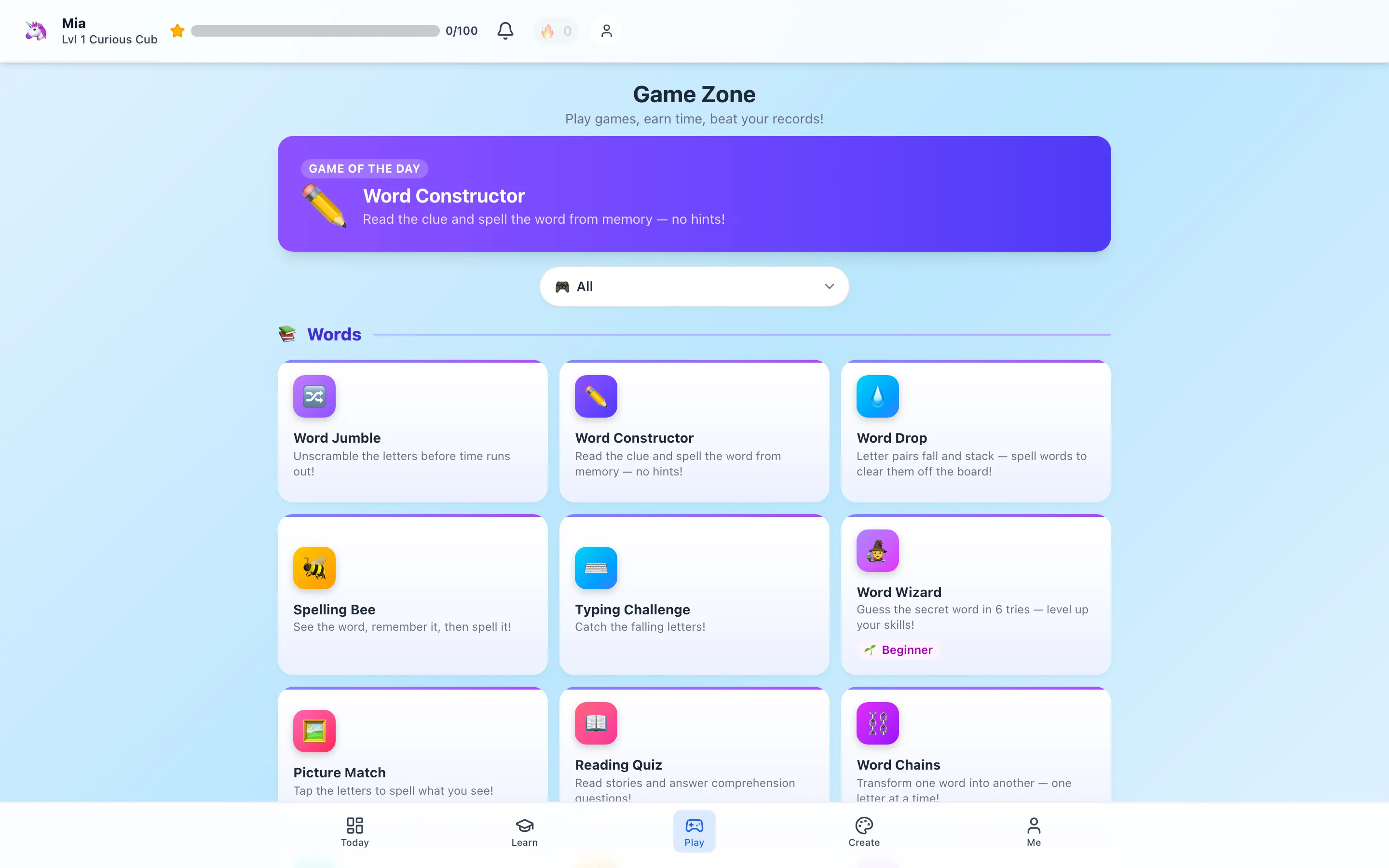
$20/month for up to four children ages 3–10: 84 games including 3D science labs, 57 courses across 14 subjects, 575 hands-on activities, 10 languages, 541 park virtual field trips, and art and music studios.
Where it wins: covers the under-8 siblings Adventure Academy can't, and goes far past four subjects. No open multiplayer, which some families specifically want. Arcade games are time-gated against a parent-set daily budget.
Where it doesn't: we stop at 10, so a 12-year-old is better served by Adventure Academy, and at $20/month we cost more than their $45/year. Full comparison.
2. Prodigy — best free game
Core math and English free; memberships roughly $5–$20/month. Math covers PreK–8, English 1–6.
Where it wins: the fantasy RPG battle loop is one of the most effective motivational designs in educational software, and the core is free. Overlaps Adventure Academy's age range well.
Where it doesn't: two subjects only, and the free tier makes membership perks visible to non-paying children during play — a pattern some parents dislike. Full comparison.
3. ABCmouse — best for the under-8 sibling
$45/year, ages 2–8, up to 3 profiles, 30-day trial. Same company as Adventure Academy.
Where it wins: it's the answer for the younger child Adventure Academy locks out, at the same price point.
Where it doesn't: it's a second subscription, not a replacement, and it stops right where Adventure Academy starts. Full comparison.
4. SplashLearn — best focused math game
About $11.99/month for math and reading; math runs PreK–grade 5. Free tier available, and free for teachers.
Where it wins: game-based like Adventure Academy but with a tighter, better-sequenced math progression. No shared online world.
Where it doesn't: reading stops at grade 2 and math at grade 5, so it's a poor fit for a 12-year-old. Full comparison.
5. Khan Academy Kids — best free option overall
Free, no ads, nonprofit, ages 2–8.
Where it wins: costs nothing, no upselling of any kind, genuinely well-made.
Where it doesn't: the age range barely overlaps Adventure Academy's. This is a sibling solution, not a swap. Full comparison.
6. Outschool — best once they're past 13
Pay per class, typically $10–$25 one-time or $12–$30 per session. Ages 3–18.
Where it wins: the only option here that keeps working into the teens, with live teachers and actual classmates — real social interaction rather than a game lobby.
Where it doesn't: no game element at all, costs scale with bookings, and you manage scheduling. Full comparison.
A note on "games that actually teach"
Worth being blunt: in most educational games the game and the learning are only loosely attached — answer a question, get a reward, return to playing. That's not automatically bad. Prodigy uses it well and children genuinely practice more because of it.
But it's worth knowing which you're buying. Adventure Academy and Prodigy wrap practice in a reward structure. Platforms like ours and SplashLearn try to make the mechanic itself the learning — a physics lab where you manipulate the variables, a word game where the constraint is the skill. Neither approach is universally better, and the honest answer is that it depends on your child.
How to pick
- Child is 11–13 → stay with Adventure Academy, or Outschool
- Younger siblings need something → ABCmouse or HomeSchool.You
- You want no open multiplayer → HomeSchool.You, SplashLearn, Khan Academy Kids
- Budget is zero → Prodigy or Khan Academy Kids
- You want more than four subjects → HomeSchool.You
Our 3-day trial requires a credit card upfront.
Methodology
Prices come from each company's published pages in August 2026. We ordered by problem, not preference, and said plainly that Adventure Academy remains the better pick for 11–13 year olds — an age we don't serve.
Frequently asked questions
Why do parents look for Adventure Academy alternatives?
Usually one of three reasons — the child is under 8 and can't use it, the parent is uncomfortable with the open multiplayer world, or they want more than the four core subjects.
What's the best alternative for a child under 8?
ABCmouse, from the same company, covers ages 2–8 at $45/year. HomeSchool.You covers 3–10 on one plan if you also have older kids.
Are there game-based alternatives without other players?
Yes. HomeSchool.You, Prodigy, and SplashLearn are all game-based without an open shared world where children meet strangers.
What's the cheapest game-based alternative?
Prodigy's core math and English content is free. Khan Academy Kids is entirely free for ages 2–8.
Which alternative goes past age 13?
Outschool, with live classes to age 18. Most game-based platforms stop well before that.
Does any alternative cover more subjects?
HomeSchool.You covers 14 subjects across 57 courses. We publish this list, so weigh that.