Inside a Spanish Lesson for Kids: Screenshots of the Number Board, Flashcards, and Listening Games
Trial offer update — September 17, 2026: HomeSchool.You's Summer Welcome Special offered a 7-day free trial with no credit card required, valid through September 15, 2026. That special is no longer active. New standard signups now receive a 3-day free trial with a credit card required upfront. The selected plan bills automatically when the trial ends unless canceled beforehand. Existing users keep their already-promised trial terms. See current plans and trial terms.
Third stop in the screenshot series (after the Solar System Lab and the Animal Kingdom Lab): what a language lesson on HomeSchool.You actually looks like. As always, these are unedited captures from the real app.
Every lesson is a short ladder, not a long drill
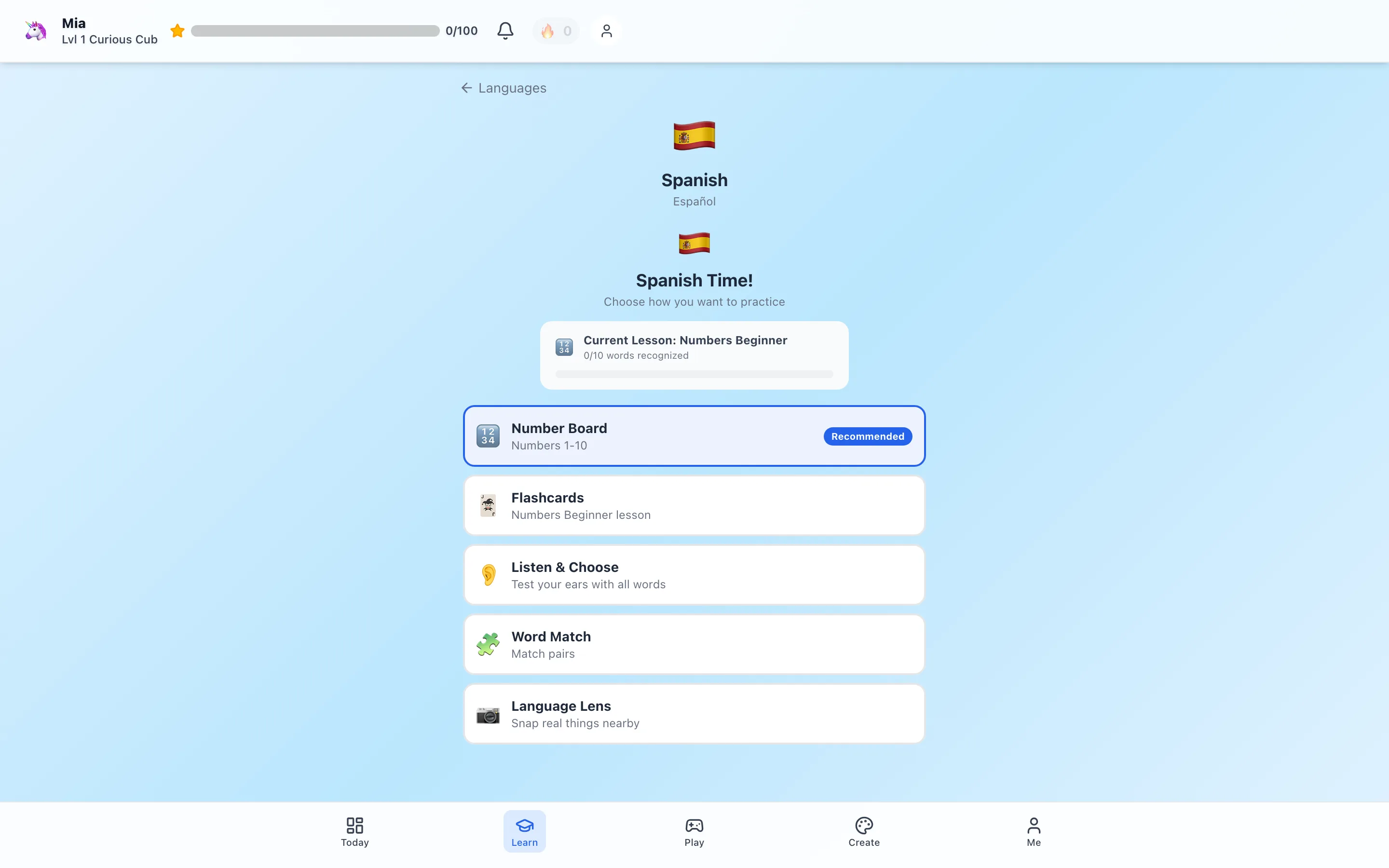
Opening Spanish doesn't dump a child into an endless lesson tree. There's one current lesson (Numbers Beginner here) and a ladder of five ways to practice it, with the recommended next step highlighted: Number Board to meet the words, Flashcards to review them, Listen & Choose to test the ears, Word Match to pair Spanish with English, and Language Lens — point the camera at real objects nearby and learn their words. The app suggests the order; the child keeps the steering wheel.
Progress is measured in words recognized (0/10 here), not minutes watched — the same evidence-over-screen-time principle as everywhere else on the platform.
The Number Board: every tile talks
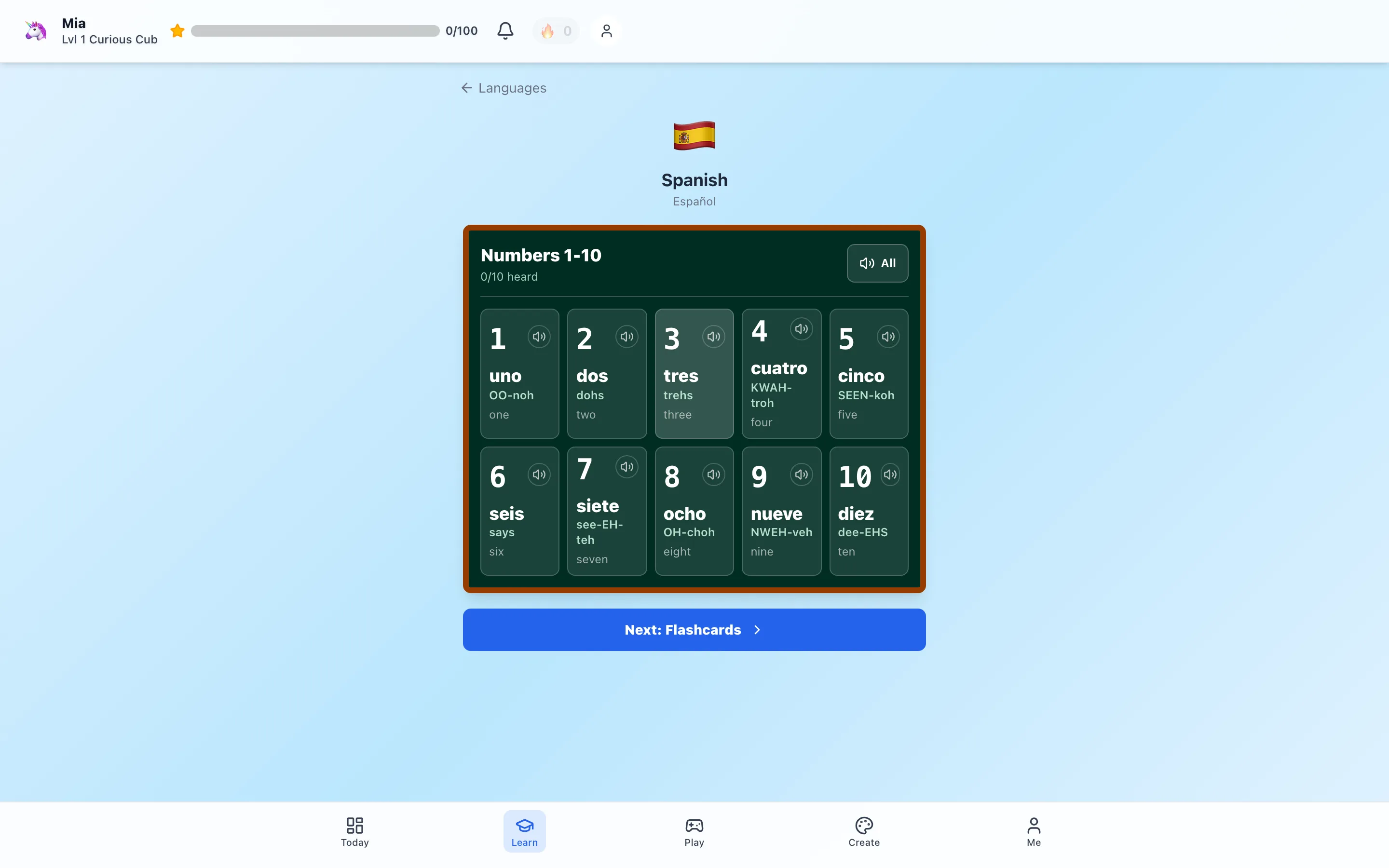
The first rung is a chalkboard of numbers 1–10. Each tile carries the numeral, the Spanish word, a phonetic hint ("KWAH-troh," "SEEN-koh," "dee-EHS"), the English word in small print, and a speaker button — tap it and the word is spoken aloud. An All button reads the whole board. A pre-reader can use this screen entirely by ear; an early reader gets the phonetics as training wheels.
Ten words is the whole lesson. That's deliberate: a 4-year-old finishes the board feeling like they speak Spanish now, which is the feeling that brings them back tomorrow. When the board's done, the big blue button hands them to Flashcards — the next rung — without a menu detour.
From recognition to recall to ears
The ladder's remaining rungs move the same ten words up the difficulty curve. Flashcards flip between Spanish and English. Listen & Choose plays the audio alone — no text — and the child picks the matching word, pure ear training. Word Match turns the vocabulary into a pairs game. By the time a child has climbed all four, they've met each word four different ways, which is spaced, multi-modal repetition wearing a game costume.
This same structure repeats across all 10 languages — Spanish, French, German, Italian, Portuguese, Mandarin, Japanese, Korean, Greek, and Russian — and across topics beyond numbers. All ten are in the base $20/month family plan (up to 4 children); languages are never an upsell.
Want to watch your own child light up at "¡diez!"? The 3-day free trial requires a credit card upfront — the Spanish board is about five taps from signup.
Frequently asked questions
How does HomeSchool.You teach languages to young kids?
Through a short practice ladder per lesson rather than long drills — a narrated word board first (every tile speaks when tapped), then flashcards, then a Listen & Choose ear-training game, then Word Match pairs. Lessons are small (about 10 words, like Numbers 1–10) so a session fits a young child's attention span.
Which languages are included?
Ten — Spanish, French, German, Italian, Portuguese, Mandarin, Japanese, Korean, Greek, and Russian — all included in the flat $20/month family plan, not sold as add-ons.
Does my child need to read to use the language lessons?
No. Every word tile and flashcard has audio — a child taps the speaker and hears native-style pronunciation, and phonetic hints (like "KWAH-troh" for cuatro) help early readers. The Listen & Choose mode is entirely ear-based.
Is this a full curriculum like a language course for adults?
No, and it isn't trying to be. It's early exposure and vocabulary building for ages 3–10 — numbers, colors, animals, food, family words — designed to make a second language feel normal and fun before formal grammar study ever starts.