Prodigy vs HomeSchool.You — An Honest Comparison (2026)
Trial offer update — September 17, 2026: HomeSchool.You's Summer Welcome Special offered a 7-day free trial with no credit card required, valid through September 15, 2026. That special is no longer active. New standard signups now receive a 3-day free trial with a credit card required upfront. The selected plan bills automatically when the trial ends unless canceled beforehand. Existing users keep their already-promised trial terms. See current plans and trial terms.
Short answer: Prodigy is a free, well-made math and English game with optional paid memberships. HomeSchool.You is a paid platform covering 14 subjects for ages 3–10. If you need math practice your kid will actually do, Prodigy's free tier is hard to beat. If you need something closer to a whole curriculum, that's a different purchase.
Side-by-side
| Prodigy | HomeSchool.You | |
|---|---|---|
| Price | Core math and English free; memberships roughly $5–$20/month | $20/month for up to 4 children |
| Subjects | Math (PreK–8), English (1–6), science with membership | 14 subjects, 57 courses |
| Ages | Roughly 5–14 | 3–10 |
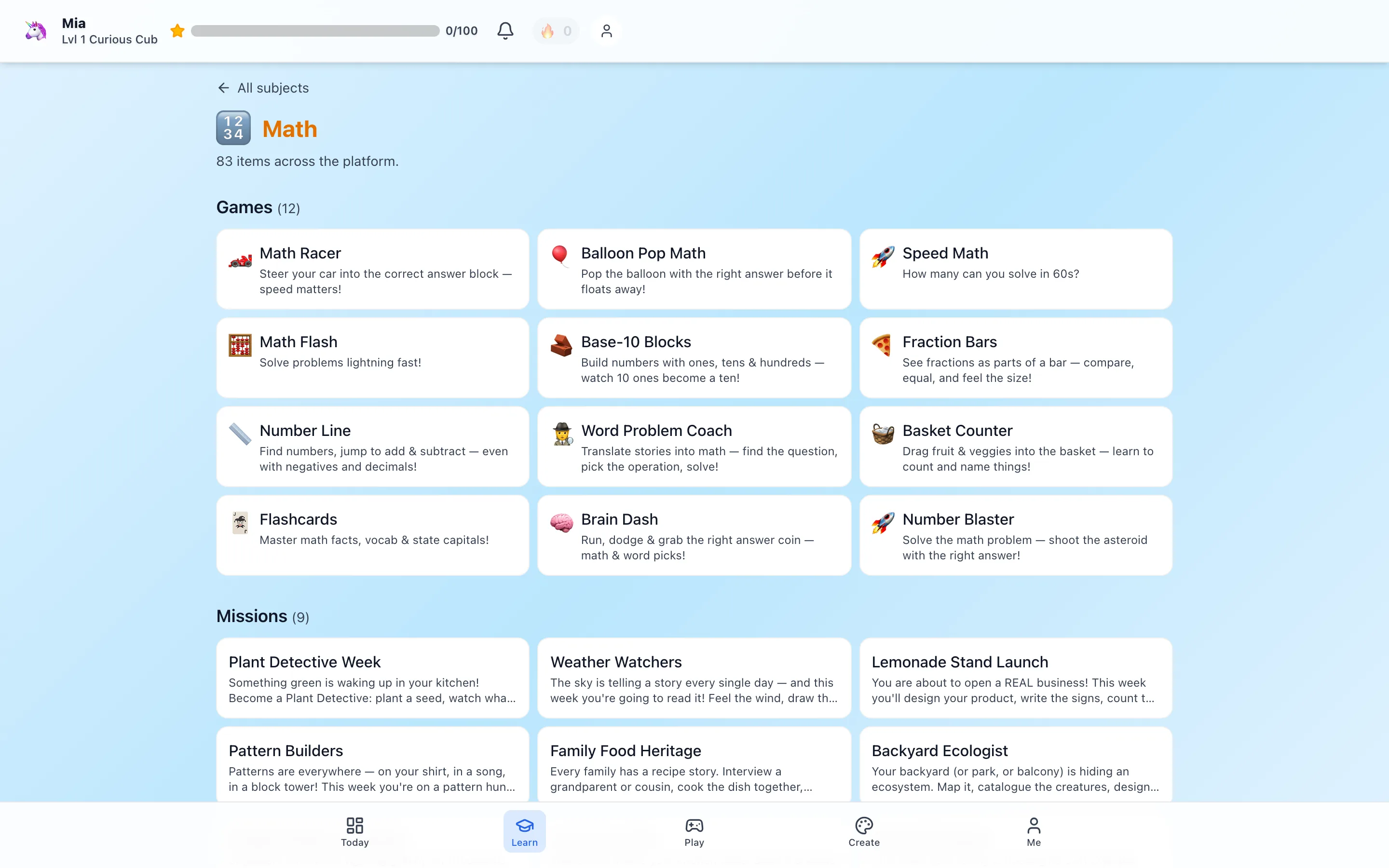
| Format | Fantasy RPG battle game | 84 games, 57 courses, 575 hands-on activities |
| Free tier | Yes, substantial | 3-day trial, then paid |
| In-game upsell to children | Yes — membership perks are visible in play | None |
| Languages | — | 10 |
| Screen-free activities | — | 575 |
| Creative studios | — | Art studio, music studio with WAV/MIDI export |
Prodigy membership pricing varies by plan, subject, and promotion; figures reflect published ranges as of August 2026.
Where Prodigy is genuinely better
The free tier is real. Core math and English content is playable without paying anything. For a family that needs math drilling and nothing else, that's a complete solution at zero cost, and we're not going to argue a $20/month product beats free for that specific job.
The math game loop works. Prodigy wraps arithmetic in a fantasy RPG where answering questions powers battles. Kids who would refuse a worksheet will grind through hundreds of problems because they want to win the fight. That's a genuine achievement in educational game design.
Curriculum-aligned math to 8th grade. Its math coverage runs deeper and older than ours, and adapts to the child's level as they play.
Very large player base. Many children already play it at school, so there's a social familiarity that lowers resistance at home.
Where HomeSchool.You is genuinely better
Subject coverage. Prodigy does math and English well and doesn't attempt the rest. Our $20 covers 57 courses across 14 subjects — science, coding, financial literacy, civics, entrepreneurship, world history, chemistry, astronomy — plus 10 languages, 541 park virtual field trips, an art studio, a music studio that exports real WAV and MIDI files, and 150 career profiles.
No upselling to your child. This is worth stating plainly. Prodigy's free model works by making membership benefits visible during play — pets, cosmetics, and rewards that member friends have and your child doesn't. It's a well-established free-to-play pattern, and some parents are entirely comfortable with it. We have no in-product purchases and nothing that markets to children, because our revenue comes from one flat subscription. Which model you prefer is a values question, not a features question.
Off-screen learning. 575 hands-on activities — cooking, nature identification, engineering builds, scavenger hunts. Prodigy is a screen game by definition. Our arcade-style games are also time-gated against a daily budget parents set, so game time is earned.
Guilt-free by design. The platform is built around a single test: when you hand a child the device, the next thirty minutes should be worth more than YouTube. That's why there's no advertising, nothing to buy inside the product, and a parent-controlled ceiling on arcade time. Prodigy clears the YouTube bar comfortably on the learning itself — the difference is what else is happening on screen while your child plays.
Works with no internet. Prodigy needs a connection to play. Ours runs fully offline once downloaded, so an old device with WiFi and cellular disabled becomes a learning-only device. Guide here.
Four children on one plan. Flat pricing regardless of how many kids use it, up to four.
How to choose
- You need math practice and nothing else: Prodigy's free tier. Start there, keep your $20.
- Your child is 11–14 and needs math: Prodigy goes further up than we do.
- You want a broader share of the school day covered: That's a different product category, and it's ours.
- You're uncomfortable with in-game upselling to kids: That's a real reason people choose us, and it's fine to weigh it.
- You want languages, art, music, or hands-on projects: Outside Prodigy's scope entirely.
Plenty of families run Prodigy for math alongside something broader. That's a sensible setup, and the free tier means it costs nothing to keep. Our 3-day trial requires a credit card upfront if you want to see what the broader half looks like.
Still comparing?
If you're weighing more than two options, we also compared the best Prodigy alternatives side by side — six to eight platforms with prices and age ranges.
Methodology
Prodigy pricing and grade coverage come from published rates and product pages as of August 2026; membership pricing varies by plan and promotion, so check current rates. Our counts come from our internal source-of-truth file. We said clearly that Prodigy's free tier is the better choice for math-only needs, because it is. We build HomeSchool.You — weigh our enthusiasm accordingly.
Frequently asked questions
Is Prodigy free?
The core Prodigy Math and Prodigy English content is free to play. Memberships add game enhancements, extra rewards, and additional content, ranging from roughly $5 to $20/month depending on plan and subjects.
What subjects does Prodigy cover?
Math (PreK–8th grade) and English (1st–6th grade), plus science content behind a membership. HomeSchool.You covers 14 subjects across 57 courses.
Which is better purely for math practice?
Prodigy, for most kids. Its math game loop is genuinely well-built and the free tier covers the core curriculum. If math practice is the only thing you need, start there.
What's the catch with Prodigy being free?
The free experience is designed to make membership perks visible to children — cosmetic items, pets, and rewards their non-member friends have. Some parents find that pressure uncomfortable; others don't mind it.
Which covers more of a homeschool day?
HomeSchool.You. Prodigy is a supplement for two subjects. Ours is built to carry a broader share of the week across 14 subjects.
Can I use both?
Easily. Prodigy's free tier costs nothing, so running it alongside anything else has no financial downside.