Miacademy vs HomeSchool.You — An Honest Comparison (2026)
Trial offer update — September 17, 2026: HomeSchool.You's Summer Welcome Special offered a 7-day free trial with no credit card required, valid through September 15, 2026. That special is no longer active. New standard signups now receive a 3-day free trial with a credit card required upfront. The selected plan bills automatically when the trial ends unless canceled beforehand. Existing users keep their already-promised trial terms. See current plans and trial terms.
Short answer: Miacademy is a structured, graded K–8 curriculum priced per child. HomeSchool.You is a game-based platform for ages 3–10 priced flat for up to four children. If you have one child and want a curriculum that functions as your spine, Miacademy is a strong choice. If you have several young children, or your problem is engagement rather than structure, we're the better value.
Side-by-side
| Miacademy | HomeSchool.You | |
|---|---|---|
| Price | $48/month per child (K–8); $516/year (~$43/mo) | $20/month for up to 4 children |
| Three children | $144/month at the regular monthly rate | $20/month |
| Older students | MiaPrep, grades 7–12; verify current offer | — |
| Lifetime option | $1,168 one child; $2,598 family up to 4 | — |
| Ages | K–8 | 3–10 |
| Structure | Graded scope and sequence, progress reports | Adaptive recommendations from a 120-node skill graph |
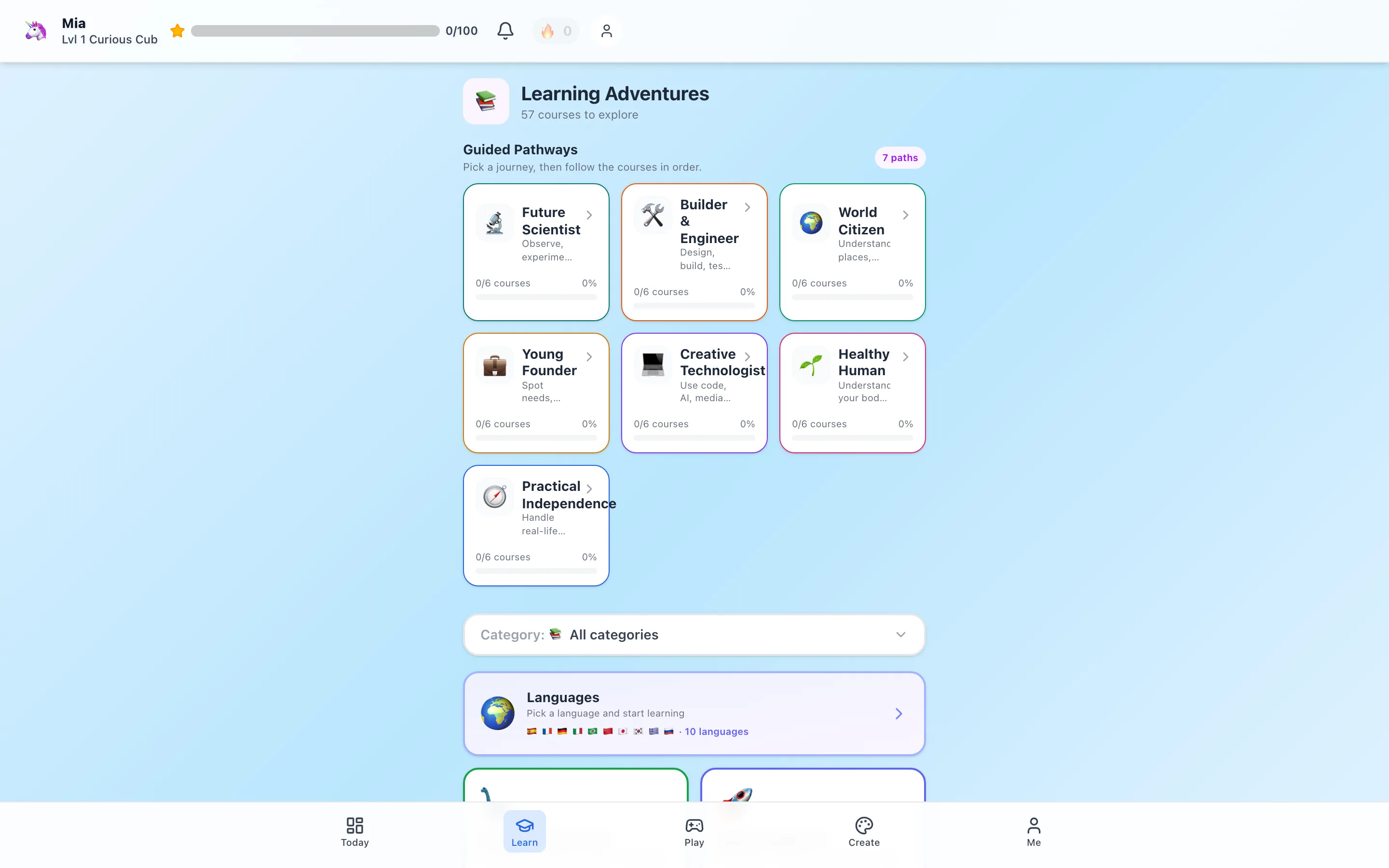
| Format | Lessons, videos, quizzes | 57 courses, 84 games, 575 hands-on activities |
| Extras | Social features, awards, some electives | 10 languages, 541 park field trips, art & music studios |
| Free trial | Varies — check current offer | 3 days, credit card required upfront |
Pricing verified against Miacademy's published parent-pricing page September 1, 2026. Temporary first-month promotions are not treated as the ongoing price.
Where Miacademy is genuinely better
It works as a complete curriculum. Miacademy's graded scope and sequence is designed to be the thing you point to when someone asks what your child is studying. It produces records, tracks completion, and follows a coherent progression. Families who want a defined spine rather than a rich supplement will find that more reassuring than what we offer.
It goes further up. K–8, plus MiaPrep for high school. Our platform stops mattering around age 10, so Miacademy will serve a family longer.
The lifetime option. If your child is young and you're confident you'll homeschool for years, $1,168 once for one child can beat monthly payments. Miacademy's $2,598 family lifetime plan can also make more sense than recurring per-child billing for a large family. Those are genuinely strong options for the right family, and nothing comparable exists on our side.
Graded records. Miacademy grades work and reports on it. HomeSchool.You creates parent-managed attendance, progress, annual-report, portfolio, and transcript-style exports, but it does not issue teacher grades or an official credit-bearing transcript. This guide explains the difference.
Where HomeSchool.You is genuinely better
Recurring per-child pricing is the story. (Full arithmetic at 1–4 children across every platform.) At Miacademy's published regular monthly price, two children are $96/month; three are $144; four are $192. We're $20 for up to four. Over twelve months with three kids, that's a $1,488 difference before promotions. Miacademy's family lifetime plan is the important exception and should be included in a multi-year comparison.
Engagement for kids who resist school. 84 games, 3D science labs, and 575 hands-on activities — many deliberately off-screen, like cooking, nature identification, and engineering builds. Arcade games are time-gated against a parent-set daily budget so screen time is earned. If your child fights structured lessons, structure isn't the fix.
Breadth included, not bolted on. 10 language programs, 541 U.S. park virtual field trips, a full art studio, a music studio that exports real WAV and MIDI, a 150-entry careers catalog, and courses in coding, financial literacy, entrepreneurship, and civics — all in the $20.
Try it for three days. A credit card is required upfront; the selected plan bills automatically afterward unless canceled.
Compare the actual learning experience
A feature table cannot show whether a child will want to return. Here are representative first-party examples from HomeSchool.You so families can inspect the work directly:
- Early literacy: Phoneme Blender pairs a reading target with immediate game feedback, while the Hearing the Sounds in Words sample exposes the lesson at four age levels.
- Upper-elementary math: families can inspect the Math Fundamentals syllabus and the interactive Fraction Bars practice tool.
- Outdoor science: Wildlife in My Backyard moves the child away from the screen to observe, record, and discuss a local habitat.
- Place-based learning: families can preview the Yellowstone field guide with place-specific observations and an age-adapted scavenger hunt.
Those examples support our claim about variety; they do not make HomeSchool.You a better fit for a family that specifically wants Miacademy's graded, sequential K–8 spine.
How to choose
- One child, K–8, you want a defined curriculum: Miacademy. That's its job and it does it.
- Child is 11+: MiaPrep, or something else entirely. Not us.
- Three or four kids under 10: The price difference is large enough to be the deciding factor on its own.
- Your child resists conventional lessons: More structure usually isn't the answer. Try the game-based approach first.
- You want a one-time payment and are in for the long haul: Miacademy's lifetime option has no equivalent here.
Our 3-day trial requires a credit card upfront if you want to see which one your kids actually open.
Still comparing?
If you're weighing more than two options, we also compared the best Miacademy alternatives side by side — six to eight platforms with prices and age ranges.
Methodology
Miacademy pricing comes from its published parent-pricing page and was rechecked September 1, 2026; verify current pricing directly because promotions and plan structures change. We use regular prices instead of temporary introductory offers. Our feature counts come from our internal source-of-truth file, and the linked samples are generated from product content. We listed Miacademy's advantages first, including the ones that can cost us the sale. We build HomeSchool.You—check anything that matters before deciding.
Frequently asked questions
Which is cheaper for a family with three kids?
On regular monthly pricing, HomeSchool.You costs less. Miacademy's published rate is $48/month per child, so three children is $144/month. HomeSchool.You is $20/month total for up to 4 children. Miacademy also publishes a family lifetime plan, which changes the long-term calculation.
Does Miacademy cover more grades?
Yes. Miacademy covers K–8, and its sibling product MiaPrep continues through grades 7–12. HomeSchool.You is built for ages 3–10. Verify MiaPrep's current price directly because it is sold separately.
Is Miacademy a complete curriculum?
It's closer to one than we are. Miacademy provides a structured, graded scope and sequence with progress reports designed to function as a family's main curriculum.
Does Miacademy have a lifetime option?
Yes. Miacademy's published pricing lists $1,168 for one child's lifetime plan and $2,598 for a family lifetime plan covering up to four children. That can be worthwhile for a family expecting years of use, though it is a large upfront commitment.
Which is better for a reluctant learner?
HomeSchool.You is built around 84 games and 575 hands-on activities specifically for kids who resist conventional lessons. Miacademy is more structured and lesson-driven.
Does either handle state reporting?
Miacademy provides graded records and progress reports. HomeSchool.You generates parent-managed attendance, progress, annual-report, portfolio, and transcript-style records, but not teacher-issued grades or an official credit-bearing transcript.