Best Prodigy Alternatives That Cover More Than Math (2026)
Trial offer update — September 17, 2026: HomeSchool.You's Summer Welcome Special offered a 7-day free trial with no credit card required, valid through September 15, 2026. That special is no longer active. New standard signups now receive a 3-day free trial with a credit card required upfront. The selected plan bills automatically when the trial ends unless canceled beforehand. Existing users keep their already-promised trial terms. See current plans and trial terms.
Disclosure: we make HomeSchool.You, which appears below. We've been clear that Prodigy's free math is hard to beat at its own job.
Prodigy's core math and English are free, with memberships roughly $5–$20/month. Math covers PreK–8th grade, English 1st–6th. The game loop works — children voluntarily do hundreds of math problems. Families look elsewhere when they need more subjects, or when the free-to-play upselling wears thin.
Be clear about what you're replacing
Prodigy is exceptionally good at one thing: getting a reluctant child to practice math. If that's working, don't replace it — supplement it. The alternatives below cover more ground; almost none matches Prodigy's motivational pull on math specifically, and the free tier means keeping it costs nothing.
Quick comparison
| Alternative | Price | Ages | Subjects |
|---|---|---|---|
| HomeSchool.You | $20/mo, up to 4 children | 3–10 | 14 subjects, 57 courses |
| Khan Academy Kids | Free | 2–8 | Literacy, math, SEL |
| SplashLearn | ~$11.99/mo | PreK–5 | Math + reading |
| Time4Learning | $39.95/mo per student | PreK–12 | Full curriculum |
| Beast Academy | $15/mo or $96/yr | 6–13 | Math (advanced) |
| Epic! | $9.99/mo or $79.99/yr | Under 12 | Reading library |
Prices verified against published company pages, August 2026.
1. HomeSchool.You — best for covering the whole week
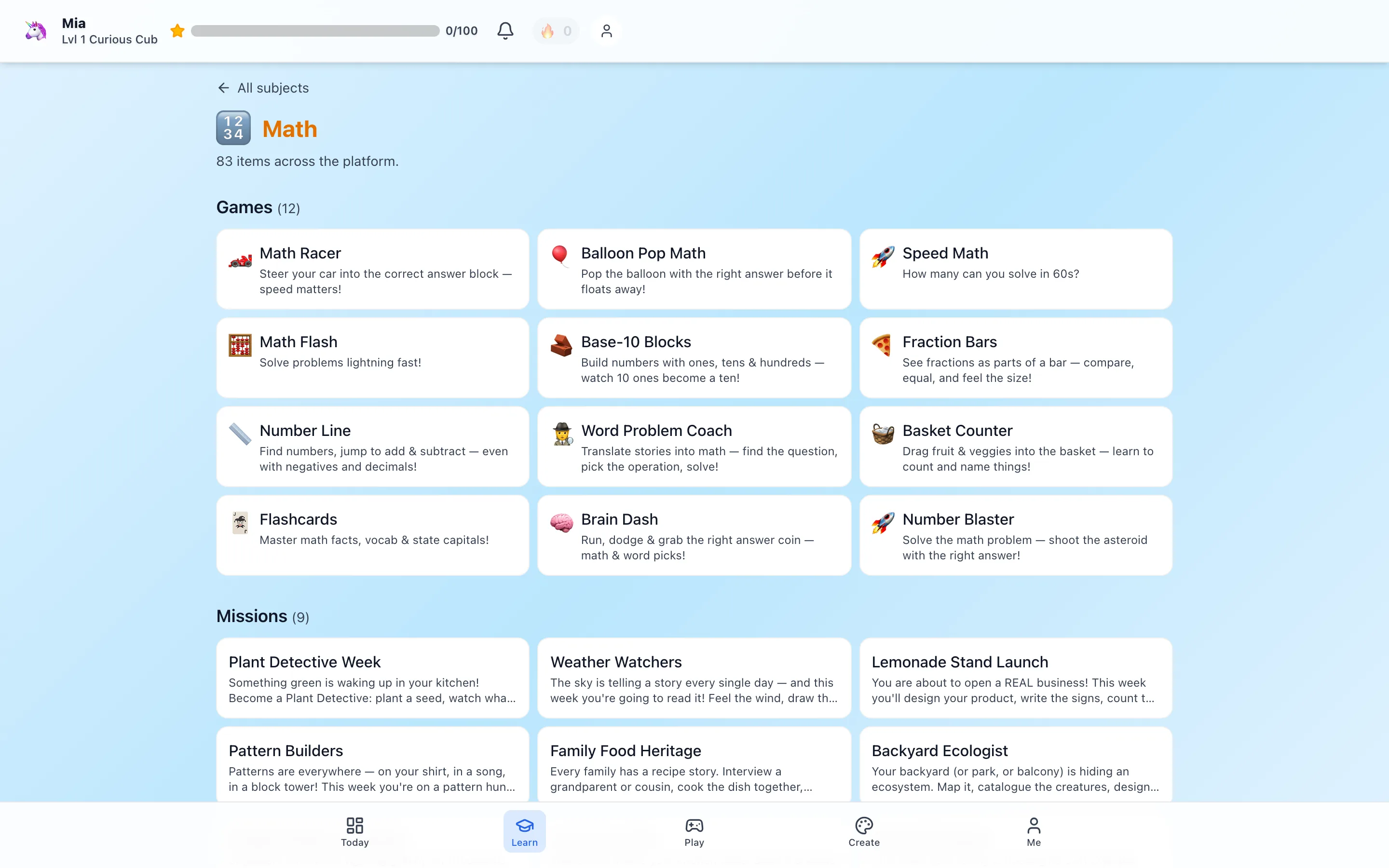
$20/month for up to four children ages 3–10: 57 courses across 14 subjects, 84 games including 3D science labs, 575 hands-on activities, 10 languages, 541 park virtual field trips, a 150-entry careers catalog, and art and music studios.
Where it wins: it's the broadest option here, and there's no in-product upselling to children — one flat subscription, nothing marketed mid-play. Arcade games are time-gated against a parent-set daily budget.
Where it doesn't: it costs $20/month against Prodigy's free tier, and our math doesn't reach 8th grade. For math motivation alone, Prodigy is better. Full comparison.
2. Khan Academy Kids — best free broader option
Free, ad-free, nonprofit, ages 2–8. Early literacy, math, and social-emotional learning.
Where it wins: free like Prodigy, but with no upselling of any kind and a stronger literacy foundation. For a family that wants free and slightly broader, this is the pick.
Where it doesn't: ends at 8, well short of Prodigy's math range. Full comparison.
3. SplashLearn — best structured math and reading
About $7.99/month for one subject or $11.99 for both. Math PreK–grade 5, reading PreK–grade 2. Free tier available and free for teachers.
Where it wins: more carefully sequenced than Prodigy, and it adds reading instruction rather than just reading practice. No in-game purchase pressure.
Where it doesn't: narrower age range than Prodigy's math, and it costs money where Prodigy doesn't. Full comparison.
4. Time4Learning — best full curriculum
$39.95/month per student, PreK–12, animated lessons and quizzes with automated attendance and grade records.
Where it wins: it's an actual curriculum rather than a supplement — the thing you point to when someone asks what your child studies. Covers high school too.
Where it doesn't: per-student pricing, and the format is far less engaging than a battle game. Full comparison.
5. Beast Academy — best for strong math students
$15/month or $96/year, ages 6–13, from Art of Problem Solving.
Where it wins: if your child races through Prodigy because the math is easy, this is the step up. Genuinely hard problem solving in a comic-book format, aimed at depth rather than repetition.
Where it doesn't: math only, and demanding enough to discourage a child who's behind.
6. Epic! — best reading companion
$9.99/month or $79.99/year for 40,000+ books, audiobooks, and videos for under-12s, with up to four child profiles.
Where it wins: Prodigy English teaches reading skills; Epic! gives children something to read. They pair naturally, and it's cheap.
Where it doesn't: it's a library, not instruction — no curriculum, no progression.
How to pick
- Math is working, you need the rest → keep Prodigy free, add HomeSchool.You
- You want free and broader → Khan Academy Kids
- Child finds Prodigy math too easy → Beast Academy
- You need a full curriculum with records → Time4Learning
- Reading is the gap → SplashLearn to teach, Epic! for volume
- The upselling bothers you → HomeSchool.You or Khan Academy Kids
Because Prodigy's core is free, the most common sensible outcome is keeping it and adding something broader alongside. Our 3-day trial requires a credit card upfront.
Methodology
Prices come from each company's published pages in August 2026; Prodigy's membership pricing varies by plan and promotion. We said openly that Prodigy is the better tool for math motivation and that keeping it costs nothing — a list that pretends otherwise would be misleading.
Frequently asked questions
Why look for a Prodigy alternative?
Usually one of two reasons — you need subjects beyond math and English, or you're uncomfortable with the in-game membership upselling children see while playing the free version.
Is Prodigy actually free?
The core math and English content is genuinely free. Memberships from roughly $5–$20/month add cosmetic rewards, pets, and extra content, and those perks are visible to non-paying players.
What covers the most subjects?
HomeSchool.You covers 14 subjects across 57 courses. We publish this list, so weigh that accordingly.
Is there a free alternative covering more than math?
Khan Academy Kids is free and covers early literacy, math, and social-emotional learning for ages 2–8, though its range is still narrower than a full curriculum.
What's the best alternative for older kids?
Prodigy's math reaches 8th grade, which is further than most game-based platforms. Power Homeschool or Outschool are the realistic options past that.
Which alternative has no upselling to children?
HomeSchool.You and Khan Academy Kids both have no in-product purchases and nothing marketed to kids during use.