National Park Scavenger Hunts for Kids by Age (3–10)
A scavenger hunt can make a child look more closely—or make the whole family rush past the place while chasing boxes. The difference is how the hunt is written.
The best park hunts are short, specific to the place, flexible by age, and impossible to “fail.” They invite noticing. They never encourage a child to approach wildlife, cross a barrier, leave an allowed route, or collect a protected object.
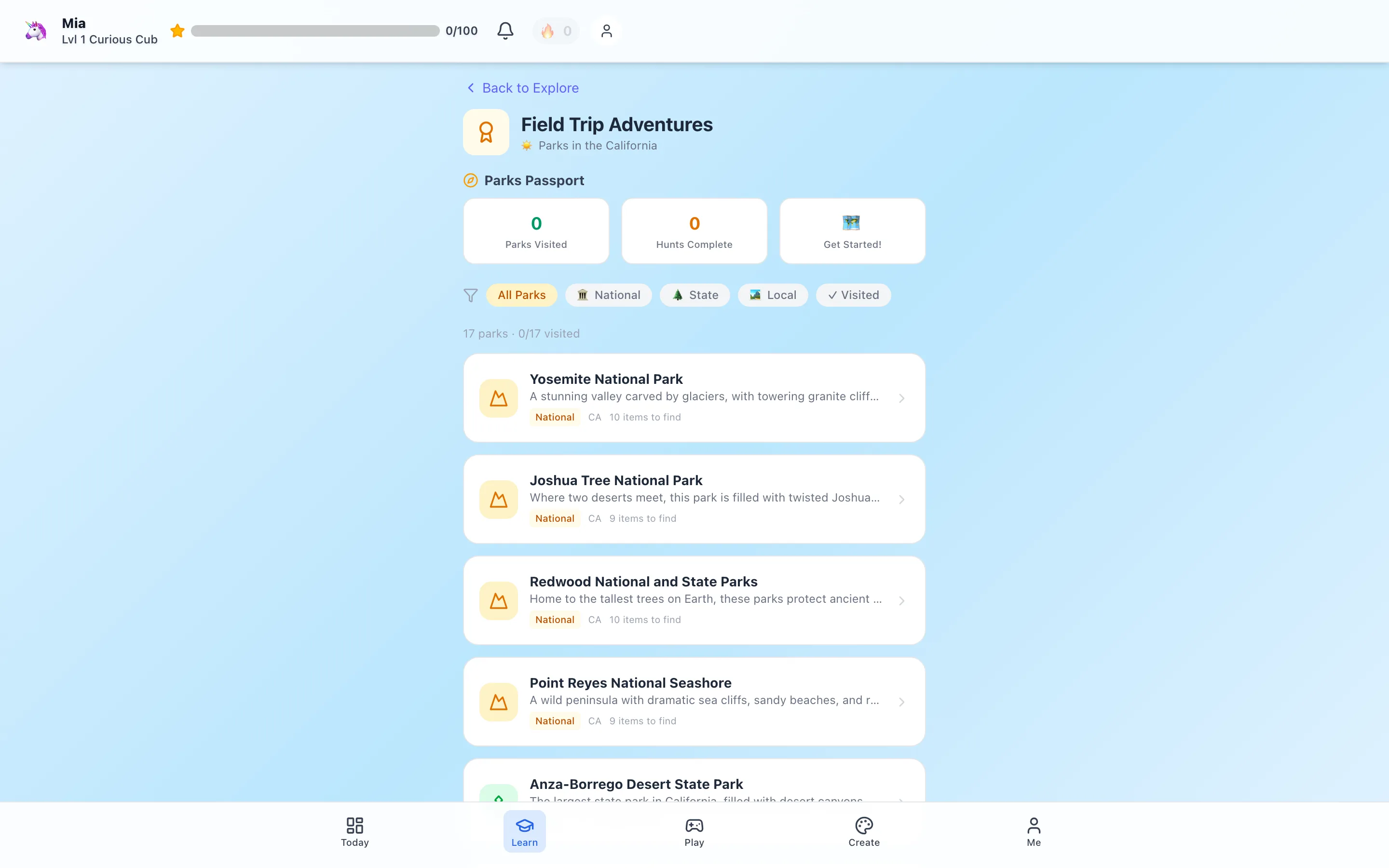
HomeSchool.You contains 541 park guides with 4,443 total observation prompts and 3,038 distinct find names. Each park has 8–10 items tied to its landscape, wildlife, geology, or history. This article explains how to use that kind of list with children ages 3–10.
The age-by-age rule
| Age | Start with | What the child does | Useful record |
|---|---|---|---|
| 3–5 | 3 finds | Points, names, matches, listens, or draws | One drawing or spoken sentence |
| 6–8 | 5 finds | Describes details and makes a connection | Labeled sketch or three observations |
| 9–10 | 6–8 finds | Classifies, compares, and supports a claim | Field notes, photo captions, or short explanation |
The numbers are starting points, not requirements. Terrain, weather, attention, accessibility, and the rest of the family's plans matter more than completing a list.
Ages 3–5: find colors, shapes, sounds, and motion
Preschool children do not need a vocabulary test. Choose large, safe observations and let sensory language do the work.
Good prompts include:
- find a rock with more than one color;
- listen for moving water;
- point to something taller than an adult;
- notice an animal sign from a safe distance;
- copy the shape of a leaf with your finger in the air.
Keep the list to three. The adult controls the route and reads the prompt. A child can “complete” the activity by explaining one thing they noticed, even if none of the planned items appeared.
Avoid prompts that imply touching, tasting, picking, climbing, or getting closer. “Find a flower” is safer than “pick a flower.” “Hear or see evidence of a bird” is better than “get a bird photo.”
Ages 6–8: add description and one connection
At this age, the child can move beyond naming:
- What two details tell you this object is different from the one beside it?
- What might this feature help a plant or animal do?
- What changed between the shady and sunny areas?
- Which observation connects to the park's story?
Choose about five items and add one small output. A labeled drawing, three spoken observations recorded by the parent, or a short caption is enough. The goal is attention and explanation, not handwriting endurance in the middle of a trail.
Ages 9–10: classify, compare, and use evidence
Older elementary children can treat the hunt as field investigation. Ask them to group observations into nature, wildlife signs, geology, and history; compare two features; and answer one question using evidence.
For example:
Claim: water helped shape this landscape. Evidence: the narrow channel, rounded stones, and deposited sand occur along the same route.
The claim does not need to be sophisticated. It needs to connect what the child says with what they actually observed. If evidence challenges the first idea, revising the answer is part of the learning.
Three place-specific examples
Yosemite National Park
A Yosemite hunt can focus on granite, water, glacial landforms, giant sequoias where accessible, and animal signs. The learning question might be: What forces shaped this valley, and what is still changing it?
Do not reduce Yosemite to “find a tree, rock, and bird.” Its identifiable landforms make geology the reason for the list. See the printable Yosemite guide.
Acadia National Park
An Acadia hunt can connect rocky coast, tides, granite, spruce-fir forest, freshwater, and signs of coastal wildlife. The question might be: What changes when ocean, rock, and forest meet?
Tide-pool observation requires special care. Check tide timing and official guidance, walk only where allowed, and never remove or pry up organisms. See the printable Acadia guide. The National Park Service also publishes Acadia education activities.
Joshua Tree National Park
A Joshua Tree hunt can focus on water-saving plant traits, contrasting desert zones, granite formations, shade, animal signs, and human history. The question might be: How does life cope with heat and limited water?
The desert makes safety part of the lesson: carry the water recommended by the park, protect against sun, keep distance from wildlife, and do not rely on cell service. See the printable Joshua Tree guide.
Write prompts that do not create bad behavior
Use wording that rewards observation without demanding access:
| Risky wording | Better wording |
|---|---|
| Touch a cactus | Observe a water-saving plant trait from a safe distance |
| Find a bear | Find a ranger-approved sign that an animal lives here; a distant sighting may count |
| Pick up a fossil | Notice a fossil display or permitted visible evidence; leave all objects in place |
| Get close enough for a photo | Use eyes, binoculars, or a zoom from the required distance |
| Find every item | Choose what is safely visible today and write “not seen” for the rest |
The hunt should explicitly say that closures, seasons, weather, route choice, and wildlife behavior affect what appears. “Not seen” is data.
Add one question before and one artifact after
A list becomes a lesson when it has a purpose and a reflection.
Before: ask one question about the place. Let the child predict.
During: observe slowly and collect only notes, drawings, or permitted photos.
After: ask the child to answer the question with one or two observations. Save a drawing, narration, photo caption, map, or paragraph if the family keeps a portfolio.
This is also how to avoid inflating an app completion. A checked box means the child reported a find; it does not prove mastery. Their explanation or work sample is better evidence.
Let children help choose the destination
In HomeSchool.You, children browse the park catalog themselves. When they heart a park, the parent receives an in-app alert and the choice enters the child's Travel Wish List. That shared step matters: it turns a scavenger hunt from an assignment imposed at a destination into preparation for somewhere the child asked to explore.
The family still decides whether and when a trip is practical. The wishlist is a conversation, not an automatic booking tool.
Print it and put the phone away
Every public park-guide preview has a print action, as does the in-app park guide. Print only the items you want, or fold the full page and mark the chosen ones. Use a clipboard only if it helps; a pocket-sized list is often less distracting.
If you use the HomeSchool.You park passport, photos, or Nature ID, bring the device out briefly and return attention to the place. Nature ID is a curiosity aid and can be incorrect. Never use it to decide what is safe, edible, touchable, or approachable.
Methodology and limits
Counts are computed from the current HomeSchool.You park catalog as of September 1, 2026. The age adaptations are practical teaching guidance, not developmental diagnoses. Conditions and park rules change; use the managing agency's official website or app before every visit. HomeSchool.You is independent and is not affiliated with or endorsed by the National Park Service or any state or local park agency.
Frequently asked questions
What should be on a national park scavenger hunt for kids?
Use observable, place-specific features such as a landform, plant adaptation, historic feature, animal sign, sound, or pattern. Treat every item as a possibility, not something a child must find.
How many scavenger-hunt items are right for a preschooler?
Start with three. For ages 6 to 8, five is usually enough. Older elementary children can handle a longer menu when the task includes comparing, classifying, sketching, or explaining rather than racing for checkmarks.
Is it safe to put wildlife on a scavenger hunt?
Only when the item can be observed from the required distance and a track, sound, nest viewed from afar, or other sign can count. Never encourage a child to approach, feed, call, touch, or chase an animal.
Should the same hunt work at every park?
A generic hunt is fine for an unplanned backyard walk, but a destination park deserves place-specific observations. The park's geology, ecology, cultural history, season, and managing agency guidance should shape the list.
Can I print HomeSchool.You park hunts?
Yes. Public sample park guides and in-app park-detail guides include a print action. HomeSchool.You has 541 park records with 4,443 observation prompts across the catalog.