State Park Homeschooling in All 50 States
State parks may be the most practical field-trip system in American homeschooling. They are spread across every state, often closer to home than a national park, and they protect far more than scenery: caves, fossil beds, battle sites, Indigenous history, industrial history, wetlands, beaches, deserts, forests, and urban wildlife corridors.
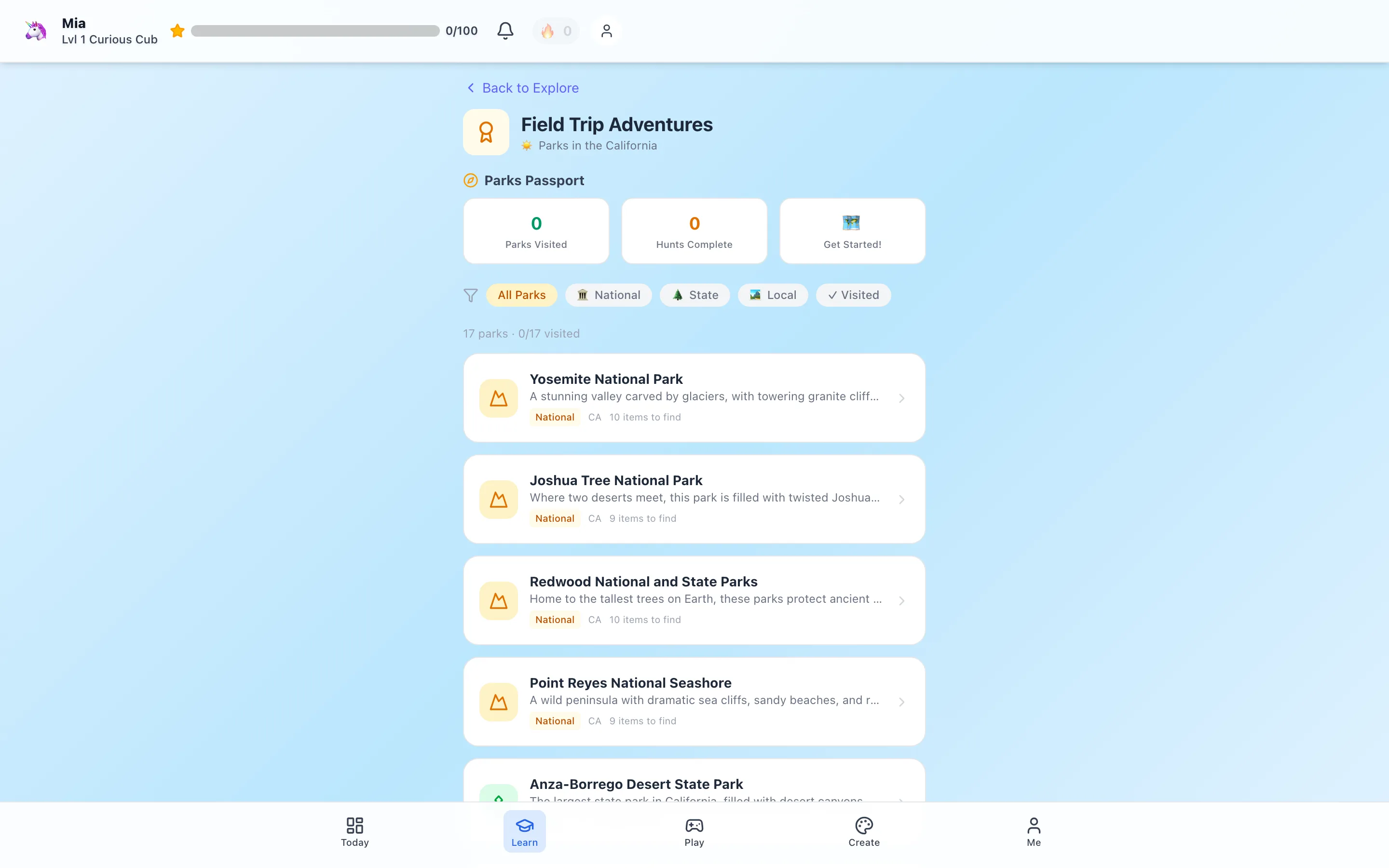
HomeSchool.You includes 541 national, state, and local parks across all 50 states. Children can search that catalog and heart places they want to explore. The parent receives an in-app alert, and the park joins that child's Travel Wish List. The family chooses the trip together, then uses a place-specific guide with 8–10 things to notice.
Below is one starting point in every state. It is not a ranking or a complete inventory. Always check the official managing agency for access, conditions, fees, reservations, programs, and rules.
A starting park in every state
| State | Park starting point | Place-based learning hook |
|---|---|---|
| Alabama | Cathedral Caverns State Park | Compare cave scale, limestone features, darkness, and underground habitat. |
| Alaska | Chugach State Park | Investigate how a vast wilderness borders Alaska's largest city. |
| Arizona | Monument Valley Navajo Tribal Park | Study sandstone buttes and learn from the Navajo Nation's own visitor guidance and cultural context. |
| Arkansas | Crater of Diamonds State Park | Ask how diamonds form and why geology concentrates materials in particular places. |
| California | Anza-Borrego Desert State Park | Compare desert adaptations, landforms, and the park's large outdoor metal sculptures. |
| Colorado | Mueller State Park | Observe how elevation shapes montane forest, meadow, weather, and wildlife habitat. |
| Connecticut | Sleeping Giant State Park | Use the ridge profile to explore shape, perspective, mapping, and local story. |
| Delaware | Cape Henlopen State Park | Compare dune, beach, bay, and ocean systems and the forces that reshape them. |
| Florida | Myakka River State Park | Investigate wetlands, river flow, canopy layers, and safe distant wildlife observation. |
| Georgia | Providence Canyon State Park | Ask how erosion and past land use helped form “Georgia's Little Grand Canyon.” |
| Hawaii | Nā Pali Coast State Wilderness Park | Study steep coastal geology while respecting route, ocean, weather, and access limits. |
| Idaho | Bruneau Dunes State Park | Explore wind, sand movement, dune shape, and the park's towering single-structure dune. |
| Illinois | Starved Rock State Park | Compare sandstone canyons, waterfalls, and the effects of glacial meltwater. |
| Indiana | Turkey Run State Park | Investigate sandstone canyons, stream action, forest layers, and trail safety. |
| Iowa | Maquoketa Caves State Park | Explore cave formation and habitat only on currently open, permitted routes. |
| Kansas | Mushroom Rock State Park | Ask how erosion can leave mushroom-shaped hoodoos behind. |
| Kentucky | Cumberland Falls State Resort Park | Measure, sketch, or compare waterfall width, drop, flow, and mist habitat. |
| Louisiana | Poverty Point World Heritage Site | Learn about monumental earthworks through the site's official Indigenous and archaeological interpretation. |
| Maine | Baxter State Park | Connect mountain elevation, the Appalachian Trail, weather, and wilderness stewardship. |
| Maryland | Calvert Cliffs State Park | Investigate deep time and fossils while following collection and cliff-safety rules. |
| Massachusetts | Mount Greylock State Reservation | Compare elevation, views, vegetation, weather, and map contours at the state's high point. |
| Michigan | Porcupine Mountains Wilderness State Park | Study a glacial lake, old-growth forest, watersheds, and changing seasons. |
| Minnesota | Itasca State Park | Ask how a river can begin small enough to walk across and become the Mississippi. |
| Mississippi | Tishomingo State Park | Compare its rocky terrain with the landforms found elsewhere in Mississippi. |
| Missouri | Ha Ha Tonka State Park | Connect geology, springs, landscape, and the ruins of an early-twentieth-century stone home. |
| Montana | Lewis and Clark Caverns State Park | Study limestone cave formation and adapted underground life with guided-access rules. |
| Nebraska | Indian Cave State Park | Use the official interpretation to study sandstone, river systems, petroglyphs, and cultural respect. |
| Nevada | Valley of Fire State Park | Observe red sandstone, light, erosion, desert heat, and ancient cultural evidence from allowed areas. |
| New Hampshire | Franconia Notch State Park | Investigate granite, waterfalls, gorge formation, and mountain weather. |
| New Jersey | Island Beach State Park | Explore a barrier-island system, dunes, coastal plants, birds, and change over time. |
| New Mexico | City of Rocks State Park | Ask why volcanic tuff pinnacles weather into forms that resemble city blocks. |
| New York | Niagara Falls State Park | Compare flow, erosion, energy, mist, and the human history of a major waterfall. |
| North Carolina | Chimney Rock State Park | Study a granite spire, gorge, elevation, river, and long-distance views. |
| North Dakota | Fort Abraham Lincoln State Park | Learn through the site's interpretation of the Mandan On-A-Slant village and later military history. |
| Ohio | Hocking Hills State Park | Compare recess caves, gorges, waterfalls, sandstone, and seasonal water. |
| Oklahoma | Joseph H. Williams Tallgrass Prairie Preserve | Observe grassland layers, fire ecology, grazing, roots, and habitat from permitted areas. |
| Oregon | Silver Falls State Park | Compare a sequence of waterfalls and ask how water, rock, and forest interact. |
| Pennsylvania | Ricketts Glen State Park | Map or compare named waterfalls while respecting steep and slippery trail conditions. |
| Rhode Island | Brenton Point State Park | Investigate coastal wind with a safe kite, weather log, or comparison of wind direction and speed. |
| South Carolina | Huntington Beach State Park | Connect beach ecology, birds, wetlands, and the history and design of Atalaya. |
| South Dakota | Custer State Park | Compare granite needles, road engineering, grassland, forest, and distant wildlife observation. |
| Tennessee | Fall Creek Falls State Park | Study waterfall height, plateau geology, streams, and forest habitat. |
| Texas | Palo Duro Canyon State Park | Investigate canyon scale, rock layers, erosion, climate, and human history. |
| Utah | Dead Horse Point State Park | Use the Colorado River gooseneck to explore erosion, elevation, scale, and map view. |
| Vermont | Smugglers' Notch State Park | Compare narrow mountain pass, cliff walls, boulders, weather, and route history. |
| Virginia | Natural Bridge State Park | Ask how water and limestone can leave a large natural arch. |
| Washington | Deception Pass State Park | Observe tides, currents, bridge engineering, coastal forest, and safe shoreline behavior. |
| West Virginia | Blackwater Falls State Park | Investigate waterfall form and the natural materials that tint the water amber. |
| Wisconsin | Devil's Lake State Park | Explore ancient quartzite, bluffs, glacial change, lake habitat, and rockfall awareness. |
| Wyoming | Hot Springs State Park | Study mineral water, temperature, deposition, and safe observation around hot water. |
How to make any state-park visit educational
Choose the strongest subject already in the place
Do not force every visit to cover every subject. A cave may naturally lead with geology and habitat. A battlefield or earthwork may lead with history, maps, and primary-source questions. A wetland may lead with water, adaptation, and food webs. Writing and art can record any of them.
Use one question and three to five observations
For ages 3–5, choose three large and safe things to notice. Ages 6–8 can describe details and make one connection. Ages 9–10 can classify evidence and explain a claim. Our age-by-age park scavenger-hunt guide gives complete examples.
Look for official youth programs
State systems often offer excellent local material. California's official Junior Ranger program runs at more than 100 state parks and connects ages 7–12 with nature, history, and science. Wisconsin's Wisconsin Explorer program offers books and activities for young visitors. Other states use different program names and schedules, so search the official state-park site rather than assuming every location participates.
Official programs and HomeSchool.You serve different jobs. The park agency provides local authority, current rules, and ranger interpretation. HomeSchool.You helps a child discover destinations across states, tell the parent “I want to go here,” carry a consistent age-adapted hunt, and connect the visit to family learning records.
Build a family exploration wishlist
Children are more invested when they can propose the place. In HomeSchool.You:
- the child searches parks by map or catalog;
- the child hearts a park;
- the parent receives an in-app alert;
- the park appears in that child's Travel Wish List;
- the family discusses distance, season, cost, access, and schedule;
- the child uses a place-specific guide and can save a park-passport memory afterward.
The wishlist is deliberately not a booking engine. A heart expresses curiosity; the parent retains the planning decision.
Safety, access, and cultural respect
Conditions change. Check the official site on the day of the visit for closures, reservations, fire or flood conditions, hunting seasons, wildlife guidance, tides, accessibility, and approved routes.
Never approach or feed wildlife, cross a barrier, enter a closed cave or trail, collect protected material, or leave an allowed route to finish an activity. At Indigenous, archaeological, military, and historic sites, use the managing community or agency's interpretation, avoid inventing stories, and treat structures and objects as evidence to respect rather than props.
HomeSchool.You park guides are independent educational previews, not official park pages. Start with the 28 public guide examples or explore how the complete 541-park family feature works.
Methodology and limits
The table selects one current HomeSchool.You catalog record per state and uses facts already attached to that park record as of September 1, 2026. It is a planning starting point, not a “best parks” ranking, route recommendation, or statement that every feature is always accessible. Official California and Wisconsin program claims come from the agency pages linked above. HomeSchool.You is not affiliated with or endorsed by any federal, state, Tribal, or local park agency.
Frequently asked questions
Can families homeschool at state parks?
Yes. State parks can support science, geography, history, art, writing, and physical education through observation and place-based questions. Programs, access, and homeschool rules vary, so verify both the park and your state's requirements.
Do state parks offer junior ranger programs?
Many do, but the name, age range, season, and availability vary. California's Junior Ranger program is offered at more than 100 state parks, and Wisconsin runs the Wisconsin Explorer program. Check the specific state's official park site.
How can children help choose a state park trip?
HomeSchool.You lets children browse parks and heart the ones they want to explore. The parent receives an in-app alert, and each choice appears in the child's Travel Wish List for the family to discuss.
Does HomeSchool.You include every U.S. state?
Yes. The catalog contains 541 national, state, and local parks across all 50 states, with 8 to 10 place-specific observation prompts per park.
Are park scavenger-hunt items guaranteed to appear?
No. Season, weather, closures, route, and wildlife behavior matter. Never approach wildlife, cross barriers, collect natural objects, or leave an allowed area to complete a checklist.