Can a Homeschool Curriculum Be Secular by Default With Optional Bible Lessons?
Trial offer update — September 17, 2026: HomeSchool.You's Summer Welcome Special offered a 7-day free trial with no credit card required, valid through September 15, 2026. That special is no longer active. New standard signups now receive a 3-day free trial with a credit card required upfront. The selected plan bills automatically when the trial ends unless canceled beforehand. Existing users keep their already-promised trial terms. See current plans and trial terms.
Families often encounter homeschool platforms at two ends of a false choice: faith woven through every subject, or no faith content anywhere in the account.
There is a third design: keep the main curriculum secular by default, then offer a clearly separated Bible course that only a parent can turn on.
That is how HomeSchool.You works. This article explains the controls precisely so parents do not have to infer what “optional” means from a marketing label.
The short answer
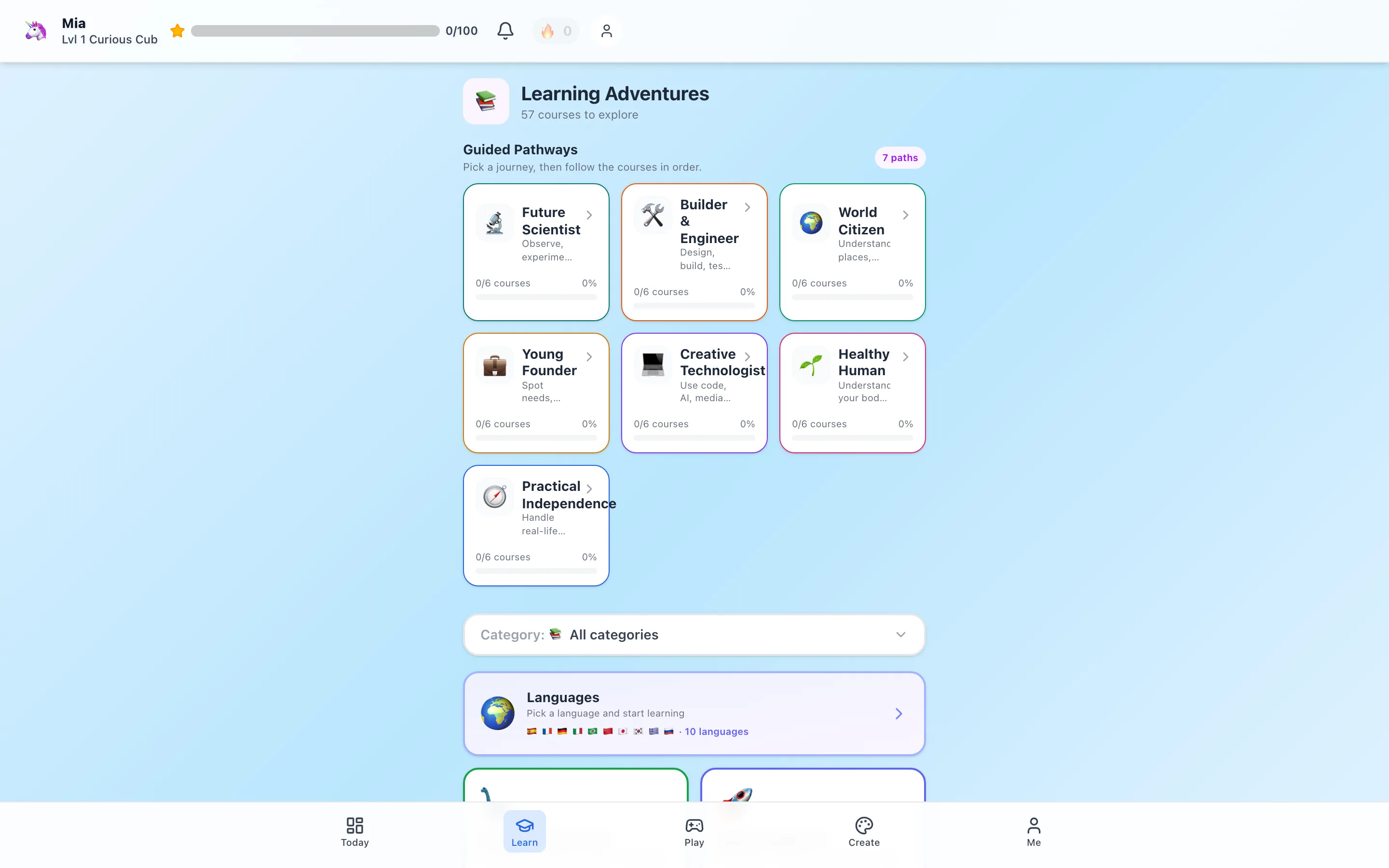
HomeSchool.You has 57 launch courses across 14 subjects in its default catalog. A separate 20-lesson Bible Foundations course brings the total to 58 when a parent enables it.
Bible Foundations is:
- Off by default
- Hidden from a child's account until enabled
- Controlled separately for each child
- A distinct course, not a filter that rewrites other subjects
- Story-first and non-denominational in approach
If a family never turns it on, the child uses the secular default experience.
What “secular by default” means here
Labels can hide more than they explain, so this is the operational definition:
- The default catalog does not require religious instruction.
- A child does not see Bible Foundations merely because the course exists in the product.
- Only a parent can enable the course from parent settings.
- The setting applies per child, not automatically to every sibling.
- Enabling the course adds Bible lessons; it does not alter science, history, reading, math, or other courses.
This separation matters for secular households, interfaith families, co-ops with varied beliefs, and parents who want religious education handled independently from academic subjects.
It also matters for Christian families who want to know that a “Bible option” is a real course rather than a few inspirational quotes scattered through unrelated lessons.
What is in Bible Foundations
Bible Foundations contains 20 lessons moving from Creation through major Hebrew Bible narratives and into the life, teachings, death, and resurrection of Jesus, then Acts and early church history. The course includes stories such as Noah, Abraham, Moses, David, Psalms, the Nativity, parables, Easter, and Paul.
Lessons quote the World English Bible, a modern-English public-domain translation. The course is designed to introduce major stories and themes in language children ages 3–10 can follow.
The approach is intentionally non-denominational. It does not attempt to resolve every theological difference among churches, and it should not be mistaken for catechism, clergy-led formation, or a replacement for a family's own tradition.
Our Christian homeschool curriculum page shows the 20-lesson sequence and the parent controls.
What enabling it does not do
Turning on Bible Foundations does not:
- Replace science lessons with a faith-based science track
- Insert religious prompts into every subject
- Change another child's account
- Make Bible work mandatory in the daily plan
- Share the family's choice publicly
It simply makes one additional course available to the selected child.
That separation is easier to understand than a global “religious/secular” switch whose effects are invisible. Parents can see the course they enabled and the rest of the catalog remains the same.
Why per-child control matters
Family settings are rarely as uniform as product categories assume.
A parent may be introducing Bible stories to an older child but not a preschooler. Siblings may have different learning plans. A co-op or microschool may serve families with different beliefs. A household may want a neutral academic curriculum while handling faith education on selected days.
Per-child control supports those real situations without asking the software to decide for the family.
HomeSchool.You already separates progress, recommendations, age adaptation, and records by child. Faith intent follows the same principle: the parent makes the decision for the particular learner.
For a broader look at managing siblings in one account, see our multiple-children cost and workflow guide.
Questions secular families should ask
If you are evaluating any platform that contains optional religious material, ask:
- Is faith content off by default?
- Can only a parent enable it?
- Is the setting global or per child?
- Is religious material confined to identifiable courses?
- Does opting out remove the content completely from the child's view?
- Does the provider explain what translation, tradition, or worldview it uses?
- Can the rest of the curriculum stand on its own?
A vague “customizable worldview” claim is not enough. You should be able to predict what the child will actually see.
Questions Christian families should ask
“Includes Bible” is equally incomplete. Ask:
- How many lessons are there?
- Which books, stories, and themes are covered?
- Is Scripture quoted, summarized, or both?
- Which translation is used?
- Is the approach denominational?
- Does the course connect to age-appropriate reading and hands-on work?
- Can a parent choose when it enters the schedule?
HomeSchool.You answers those questions openly: 20 lessons, World English Bible quotations, story-first instruction, non-denominational framing, and a parent-controlled opt-in.
The rest of the platform stays the same
With or without Bible Foundations, the subscription includes the complete platform for ages 3–10:
- 57 default courses and 1,000+ lessons across 14 subjects
- 575 hands-on activities
- 84 educational and arcade-style games with parent controls
- 10 language programs
- 541 U.S. park guides and field-trip activities
- Art and music studios
- Parent-managed progress, attendance, portfolio, annual-report, and transcript-style tools
HomeSchool.You is not an accredited school and does not issue official credit-bearing transcripts. The records guide explains what those parent tools generate.
Who this setup is for—and who it is not
This design can fit:
- Secular families who want assurance that faith content will stay absent unless chosen
- Christian families who want a Bible course beside a broad academic platform
- Interfaith or mixed-belief households
- Families who want different settings for different children
- Small learning groups that need visible, parent-controlled boundaries
It may not fit a family seeking a curriculum where one specific theology is integrated through every academic subject. It also does not replace church instruction, a denominational curriculum, or an accredited religious school.
Families comparing faith-specific resources can also read our Christian curriculum comparison and free Bible lesson guide. Both distinguish a complete faith-integrated curriculum from an optional Bible course.
Editorial note
This is a first-party explanation written by the team that built the setting and the Bible Foundations course. The goal is to describe the boundary accurately, not to tell a family which worldview to choose. You can see the default catalog in our complete curriculum overview or use the 3-day card-required trial to inspect the controls directly.
Frequently asked questions
Is HomeSchool.You a secular homeschool curriculum?
The main curriculum is secular by default. Bible Foundations is a separate optional course that stays hidden unless a parent explicitly enables it for an individual child.
Can one child use Bible lessons while a sibling does not?
Yes. Faith content is controlled per child, so a parent can enable Bible Foundations for one child while leaving it unavailable to another.
Does enabling Bible Foundations change the science curriculum?
No. It adds a separate Bible course; it does not replace or rewrite the platform's math, reading, science, geography, language, or creative courses.
What Bible translation does the course use?
Bible Foundations quotes the World English Bible, a modern-English public-domain translation.
Is the Bible course denominational?
It is designed as a story-first, non-denominational introduction. Families and churches remain responsible for denominational teaching and interpretation.